
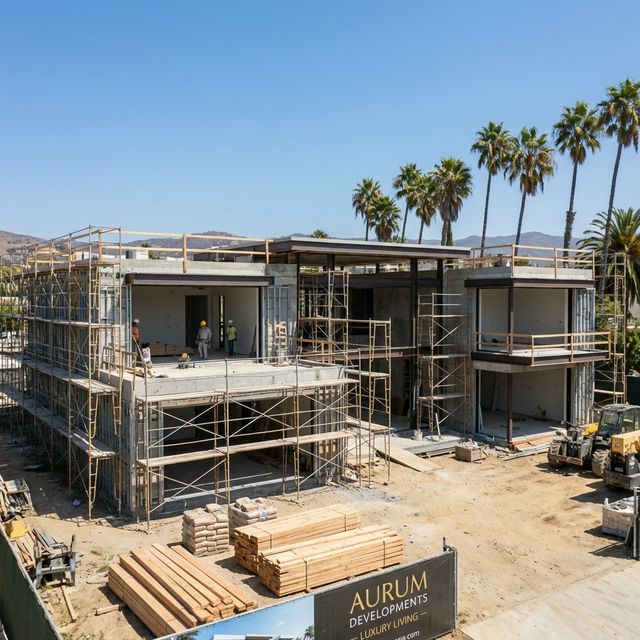
One missing interface item between a blockwork package and a services package, followed through in illustrative riyals to show how a small gap becomes a large cost.
Scope gaps rarely involve expensive work. They involve cheap work that nobody priced, discovered at a moment when fixing it is expensive. This example follows a single omitted interface item through a project to show how the cost multiplies, and where it could have been stopped at each stage. All figures are illustrative.
The situation
On a four storey building the blockwork package and the mechanical services package were let separately. The blockwork scope said nothing about forming openings for ductwork, and the services scope excluded builders work in connection with its installation. Neither subcontractor priced it. The gap is discovered when the duct installer arrives on the second floor and finds solid walls. Every figure below is an illustrative assumption used to demonstrate the method.
Assumptions (illustrative)
- Openings required: 60 across four floors, each roughly 0.5 metres by 0.4 metres through 200 millimetre blockwork.
- Cost if included in the blockwork package at tender: an allowance of 85 riyals an opening, so 5,100 riyals.
- Cost of cutting after the blockwork is built and rendered: an estimated 310 riyals an opening including making good.
- Services package labour standing idle while the position is resolved: a crew of three at a cost of 1,800 riyals a day.
- Resolution time while the parties argue and a quotation is obtained: six working days.
- Programme effect: the services package start slips by eight working days, with the finishes behind it.
Step 1: Price the work as it should have been bought
Sixty openings at 85 riyals, formed as the blockwork was built, is 5,100 riyals. At that stage the blocklayer leaves the opening rather than cutting it, so the work is almost free of waste and needs no making good.
This is the benchmark. Everything that follows is the premium paid for not having assigned the item to a package before either subcontract was let.
Step 2: Price the work as it now has to be done
Sixty openings at 310 riyals is 18,600 riyals. The increase of 13,500 riyals reflects cutting through completed and finished walls, dust control in an occupied area of the site, waste removal and making good both faces.
The same physical result now costs over three times as much. This is the most visible part of the cost and, as the next steps show, not the largest part.
Step 3: Add the standing time while the gap is resolved
The services crew stands for six days at 1,800 riyals a day, giving 10,800 riyals. Whether the main contractor bears it depends on the subcontract terms, but somebody in the chain pays it and it will be claimed.
Standing time is the cost of the argument rather than the cost of the work. It accrues daily while two parties exchange letters about a scope item worth 5,100 riyals.
Step 4: Add the programme consequence
The services start slips eight working days. If the follow on finishes cannot start until the first fix is signed off, and the site preliminaries run at an illustrative 4,500 riyals a day, eight days of knock on exposure is 36,000 riyals before any question of damages.
The programme effect is usually the largest number and the one nobody estimates at the time. It also puts the main contractor in the position of claiming time for a gap in its own packaging, which is rarely successful.
Step 5: Total the cost of the gap and attribute it
The additional cutting cost of 13,500 riyals, plus standing time of 10,800 riyals, plus programme exposure of 36,000 riyals, gives 60,300 riyals arising from an unassigned item worth 5,100 riyals, a multiple of nearly twelve.
Attribution is the uncomfortable part. Neither subcontractor priced the work because neither was asked to, so the cost usually lands with the party that wrote the packages, which is the main contractor.
Step 6: Identify the three points where it could have been stopped
First, at the interface schedule, where the item would have been assigned for the cost of an hour of someone time. Second, at bid evaluation, where asking both bidders whether they had allowed for openings would have revealed that neither had. Third, at the pre start meeting for the blockwork package, where a walk through the interfaces would have caught it before a single block was laid.
Each control costs an hour or less. The value of the interface schedule is not that it is clever; it is that it forces a question nobody asks spontaneously.
What changes the answer
- Discovery timing: caught on the first floor rather than the second, the cutting cost falls and the standing time may disappear entirely, which is why early coordination checks pay disproportionately.
- Finish state: cutting through unfinished blockwork is far cheaper than cutting through rendered and painted walls, so the same gap costs more the later it is found.
- Programme position: if the services package was not on the critical path, the programme exposure of 36,000 riyals largely disappears and the whole event becomes a modest commercial adjustment.
- Subcontract terms: a services subcontract that expressly excludes builders work shifts the argument but not the cost, and a blockwork subcontract silent on openings leaves the main contractor with no recovery.
- Number of occurrences: a single gap of this kind is absorbable, but the same packaging weakness typically produces several, and they arrive in the same months.
What the numbers tell you
- Scope gaps are almost never about expensive work; they are about cheap work discovered expensively.
- The cost of a gap is dominated by standing time and programme effect rather than by the work itself.
- The party that wrote the packages usually pays, because neither subcontractor was asked to price the item.
- An interface schedule prepared before tender is the cheapest control available and has to be checked at bid evaluation to be effective.
- Pre start meetings that walk the interfaces catch what a document review misses, because the people who will actually build the work are present.
Limits of this example
Every figure above is an illustrative assumption used to show the method, not a quote, valuation or market rate. Costs, rates, fees and regulations change and must be confirmed with the relevant authority, lender or supplier before you commit.
Domira builds and supervises projects across Saudi Arabia, and the commercial discipline above is how its projects stay inside their budget and their programme. Send the drawings, the contract or the site and Domira will tell you where the risk actually sits.
Frequently Asked Questions
What is builders work in connection with services?
It is the building work needed to allow a services installation to proceed: forming and making good openings, bases and plinths for plant, supports and fixings, chases, ducts and holes, and sealing afterwards. It sits between trades, which is exactly why it gets excluded by both. Assign it explicitly to one package, item by item, before either package is tendered.
Who pays when two subcontractors both exclude the same work?
Usually the main contractor, because neither subcontractor was asked to price the work and neither has a contractual obligation to perform it. The commercial position follows the scope documents, so an item absent from both scopes is an unpriced cost in the main contract. That is why the interface schedule is a main contractor protection rather than a coordination nicety.
How do I check that a subcontract bid includes the interface items?
Include the relevant extract of the interface schedule in each package scope document, then ask every bidder to confirm in its return that it has allowed for the listed items. At evaluation, check that confirmation rather than assuming it. A bidder that quietly excluded an interface item will be cheaper on paper and more expensive in practice.
Have a Property Question?
Domira can help you navigate property, financing and investment decisions in Saudi Arabia. Speak with our team for an initial consultation.
