
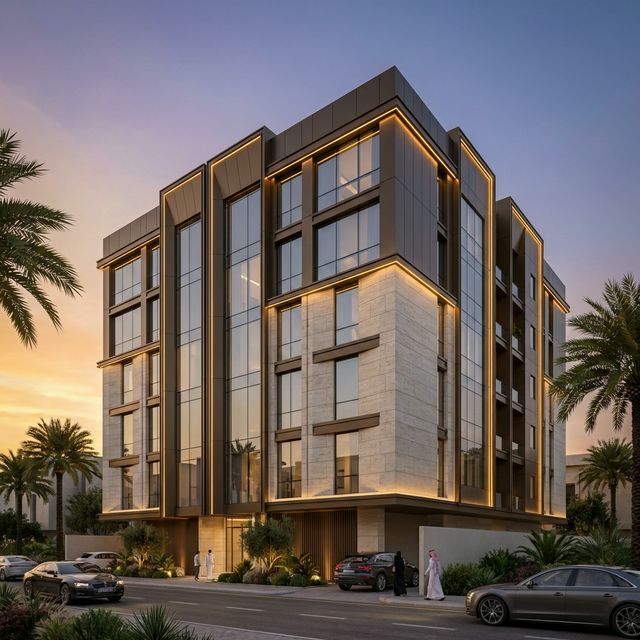
An illustrative calculation showing how an owner moves from a list of loads to a generator rating, a UPS autonomy and an honest annual running cost.
Backup power is sized from the loads you genuinely need during an outage, not from the total connected load of the building. Separating essential loads from the rest usually halves the generator rating and changes the economics completely. The worked example below shows the arithmetic, using illustrative figures to demonstrate the method rather than to quote a price.
The situation
A four storey office building in Riyadh with a small data room is experiencing occasional utility interruptions. The owner wants cooling to the data room, lighting on escape routes and in core areas, one lift, the fire systems and the data room equipment to continue through an outage. Everything else, including general office cooling and tenant power, may stop. The task is to size a standby generator, decide what needs an uninterruptible supply, and estimate the annual cost of holding that capability.
Assumptions (illustrative)
- Essential load list: data room cooling 40 kW, core and escape lighting 15 kW, one lift 20 kW, fire and life safety 10 kW, data room equipment 25 kW.
- Non essential load excluded from the generator: general office cooling and small power, assumed 260 kW.
- Diversity applied to essential loads: 0.85, reflecting that the lift and cooling do not peak together.
- Spare capacity allowance for future load: 20 per cent above the diversified figure.
- Illustrative installed cost of the generator package: SAR 3,200 per kW of rating.
- Illustrative fuel consumption at typical load: 0.28 litres per kWh produced, with fuel at SAR 1.10 per litre.
Step 1: Total the essential loads
40 + 15 + 20 + 10 + 25 = 110 kW of connected essential load.
This is the honest starting point. Against a building total of roughly 370 kW, the essential list is under a third, which is why sizing from the main incomer would have produced a generator three times larger than required.
Step 2: Apply diversity
110 kW multiplied by 0.85 gives 93.5 kW of expected simultaneous demand.
Diversity reflects that the lift motor draws its peak briefly and not at the same moment as peak cooling. The factor should be justified by the designer against the actual equipment rather than taken from habit.
Step 3: Add spare capacity and select a rating
93.5 kW multiplied by 1.20 gives 112.2 kW, so the owner selects a 125 kW standby set from the available range.
Generators come in steps, so the selection rounds up to the next available rating. The 20 per cent allowance covers load growth and the motor starting current that a running engine must absorb without excessive voltage dip.
Step 4: Price the installed capability
125 kW multiplied by SAR 3,200 per kW gives SAR 400,000 for the generator package.
This illustrative figure represents the set, enclosure, base tank, changeover panel and installation. Had the owner sized from the full building load at 370 kW, the comparable figure would have been around SAR 1.18 million for capability that is never used.
Step 5: Size the uninterruptible supply for the gap
The data room equipment at 25 kW must ride through the 15 seconds before the generator takes load, plus 10 minutes of margin for an orderly shutdown if the generator fails to start. A UPS supporting 25 kW for 10 minutes requires roughly 25 multiplied by 10 divided by 60, which is 4.2 kWh of usable battery energy, before allowing for inverter efficiency and end of life capacity.
The generator handles duration and the UPS handles continuity. Sizing the UPS for hours rather than minutes is a common and expensive error once a generator is present.
Step 6: Estimate annual running cost
Assume 20 hours of real outages per year at an average 70 kW, giving 1,400 kWh, plus monthly test runs of 30 minutes at 50 kW, giving 12 multiplied by 0.5 multiplied by 50, which is 300 kWh. Total 1,700 kWh. Fuel at 0.28 litres per kWh is 476 litres, costing roughly SAR 524. Add an illustrative annual service contract of SAR 18,000 and a battery and consumables allowance of SAR 6,000, giving about SAR 24,500 a year.
Fuel is trivial and maintenance dominates. This is the line owners forget: standby power costs money every year whether or not the utility ever fails, and a set that is not serviced will not start when it is needed.
What changes the answer
- If the owner adds general office cooling to the essential list, the rating roughly quadruples and the capital cost rises in proportion.
- If outage hours triple, fuel cost rises to around SAR 1,500 a year, which barely changes the total because maintenance dominates.
- If the UPS autonomy is specified at 60 minutes instead of 10, battery cost and room space rise sharply for a benefit the generator already provides.
- If the generator is installed indoors, add ventilation, exhaust routing, acoustic treatment and fuel storage arrangements that can exceed the cost of the set.
- If the site has fuel storage above a certain volume, additional approvals and containment requirements may apply and must be confirmed with the relevant authority.
What the numbers tell you
- Size from the essential load list, because the gap between that list and the building total is where the money is.
- Decide what may stop during an outage before anyone quotes, since this single decision moves the cost more than any equipment choice.
- Use the UPS to bridge seconds and allow an orderly shutdown, and let the generator carry duration.
- Budget the annual maintenance cost explicitly, as it is the dominant running cost of standby power.
- Test under genuine load on a schedule, because an untested set is an expensive assumption rather than a capability.
Limits of this example
Every figure above is an illustrative assumption used to show the method, not a quote, valuation or market rate. Costs, rates, fees and regulations change and must be confirmed with the relevant authority, lender or supplier before you commit.
Domira works on buildings that already exist: surveying what is installed, specifying the systems that have to be replaced, and running maintenance and refurbishment work around the people using the property. Tell Domira which asset you are responsible for and we will say what we would inspect first.
Frequently Asked Questions
How do I decide what loads go on the generator?
Start by asking what must not stop: life safety systems, escape lighting, at least one lift, security, and any equipment where an interruption causes loss beyond the outage itself, such as a data room or cold storage. Everything else is a business decision about comfort versus cost. Write the list before any supplier sizes equipment, because suppliers reasonably assume more rather than less.
Do I need a UPS if the building already has a generator?
Yes, for any load that cannot tolerate the seconds between the supply failing and the generator taking load, and for a controlled shutdown if the generator does not start. Sizing it for minutes rather than hours keeps it affordable. Loads that can tolerate a short break, such as lighting and general cooling, do not need battery backup at all.
How often should a standby generator be run and tested?
A short no load start proves the engine will turn over, but only a test under real load proves the set can carry the building. Most owners run a brief monthly test and a longer loaded test annually, following the manufacturer recommendations and any condition attached to their approvals. Record every test, including the load achieved and any fault observed.
Have a Property Question?
Domira can help you navigate property, financing and investment decisions in Saudi Arabia. Speak with our team for an initial consultation.
