
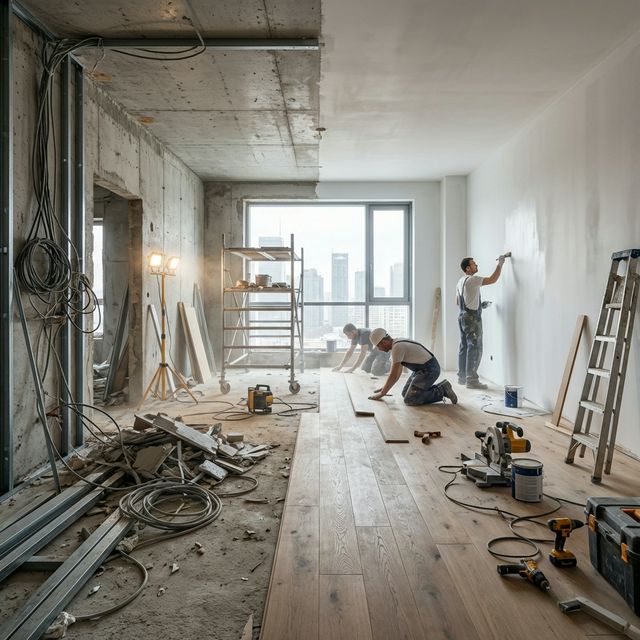
An illustrative calculation of subdividing a large villa into separate units, covering access, services separation, metering, permissions and the cost per unit.
Subdividing a villa into separate lettable units is attractive because total rent from several units usually exceeds the rent from one large house. Delivering it requires independent access to each unit, separated services with individual metering, acoustic and fire separation between units, and permission for the resulting use. The example below prices those elements against an illustrative case.
The situation
An owner holds a large two storey villa in Jeddah of 640 square metres with an annexe, currently let as a single household property. The proposal is to create four separate units: two on the ground floor, one on the first floor and one in the annexe. The questions are what the physical works cost, what has to be separated, and whether the rent uplift justifies the project.
Assumptions (illustrative)
- Gross internal area 640 square metres including an annexe of 90 square metres.
- Current rent as a single property: illustrative SAR 180,000 per year.
- Target: four units of approximately 200, 160, 190 and 90 square metres.
- Illustrative cost of separating and forming independent access, including a new external stair: SAR 185,000.
- Illustrative cost of fire and acoustic separation between units including upgraded doors: SAR 165,000.
- Illustrative cost of services separation, individual metering and additional kitchens and bathrooms: SAR 520,000.
Step 1: Total the conversion cost
185,000 plus 165,000 plus 520,000 gives SAR 870,000, which across 640 square metres is SAR 1,359 per square metre.
Services separation dominates, because each unit needs its own kitchen, bathrooms, water heating, electrical board and metering. These are the works that convert one dwelling into four, and they cannot be reduced by simplifying the finishes.
Step 2: Establish the rent after subdivision
If the four units let at illustrative annual rents of SAR 85,000, SAR 72,000, SAR 80,000 and SAR 48,000, the total is SAR 285,000 per year against SAR 180,000 today, an uplift of SAR 105,000.
The uplift is 58 per cent, which is typical of subdivision economics: smaller units command more per square metre, because the market for them is deeper than the market for one very large house.
Step 3: Calculate the simple recovery period
SAR 870,000 of conversion cost divided by SAR 105,000 of additional annual rent is 8.3 years.
This is longer than owners usually expect and it ignores the additional operating cost of running four tenancies instead of one, which makes the real period longer still.
Step 4: Add the operating difference
Four tenancies instead of one adds management cost, more frequent voids and turnover, and maintenance across four kitchens and additional bathrooms. Allowing an illustrative SAR 22,000 a year reduces the net uplift to SAR 83,000 and extends the recovery period to 10.5 years.
Subdivision converts a passive asset into a managed one. The operating difference is real and persistent, and leaving it out of the calculation overstates the return by a wide margin.
Step 5: Test the permission constraint
If the permitted use for the plot does not allow multiple dwellings, or if the parking requirement for four units exceeds what the plot provides, the project cannot proceed as planned regardless of the arithmetic.
Permission is binary and comes first. The cost of confirming it is a fraction of a per cent of the project, and proceeding without it risks an unauthorised conversion that cannot be let legitimately or sold easily.
Step 6: Compare against the alternative of partial subdivision
Separating only the annexe as an independent unit might cost an illustrative SAR 150,000 and raise rent by SAR 48,000 on the annexe while the main house lets for SAR 150,000, giving total rent of SAR 198,000 and a recovery period of about 8.3 years on a far smaller commitment.
Partial subdivision often produces a similar return on a much smaller investment and with far less disruption, because the annexe is already physically separate. It is the option owners most often overlook while planning a full conversion.
What changes the answer
- If permission or parking provision cannot be satisfied for four units, the scheme fails regardless of the construction cost.
- If services separation proves more complex because of concealed distribution, the largest cost line grows.
- If achievable rents for smaller units are lower than assumed, the recovery period extends proportionally.
- If voids are higher with four tenancies than assumed, the net uplift falls and management cost rises.
- If the structure requires work to form the new access or openings, add that cost before comparing options.
What the numbers tell you
- Confirm permitted use and parking before pricing anything, because permission is binary.
- Expect services separation and additional wet areas to dominate the cost of any subdivision.
- Include the ongoing management and void cost, since four tenancies behave differently from one.
- Price partial subdivision as a genuine alternative, particularly where an annexe is already separate.
- Treat fire and acoustic separation between units as essential rather than as an optional improvement.
Limits of this example
Every figure above is an illustrative assumption used to show the method, not a quote, valuation or market rate. Costs, rates, fees and regulations change and must be confirmed with the relevant authority, lender or supplier before you commit.
Domira works on buildings that already exist: surveying what is installed, specifying the systems that have to be replaced, and running maintenance and refurbishment work around the people using the property. Tell Domira which asset you are responsible for and we will say what we would inspect first.
Frequently Asked Questions
Can a villa be divided into separate rented apartments in Saudi Arabia?
Subdivision depends on the permitted use for the plot, the parking requirement for the resulting number of units and the applicable building requirements for separate dwellings. These are set by the relevant authorities and vary by location, and they are revised over time. Confirm the position for your specific plot in writing and take advice from a licensed adviser before committing.
What has to be separated when creating multiple units in one building?
Independent access to each unit, electrical supply and distribution with individual metering, water supply and preferably individual metering, drainage, cooling, and fire and acoustic separation between units including the doors onto any shared circulation. Each unit also needs its own kitchen and sanitary provision, which is usually the largest part of the cost.
Does subdividing a property increase its value?
It can increase the income, which usually supports value, but it also changes what the asset is and who will buy it. A subdivided building appeals to investors rather than to families, and if the conversion was done without the necessary permissions it can reduce value and complicate a sale. Keep the approvals documentation with the title records.
Have a Property Question?
Domira can help you navigate property, financing and investment decisions in Saudi Arabia. Speak with our team for an initial consultation.
