
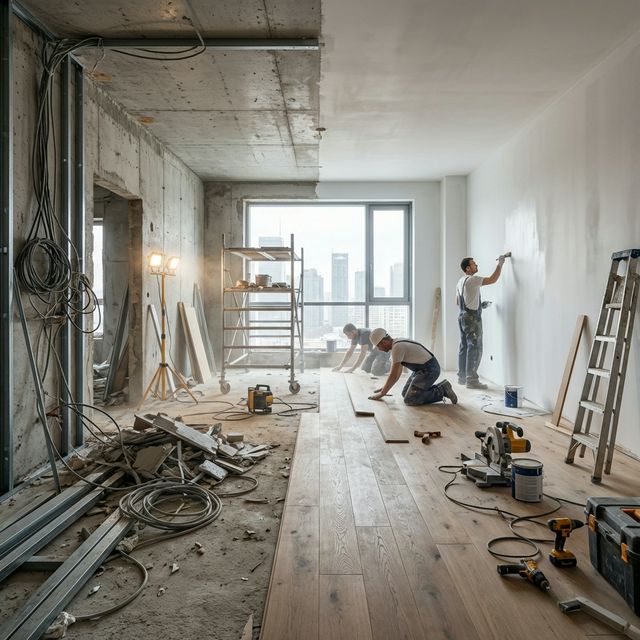
An illustrative calculation of what rewiring an occupied residential block costs, phase by phase, and where partial rewiring makes sense.
Rewiring is rarely all or nothing. Most older buildings need the distribution boards, protective devices and earthing arrangement brought up to current expectations, while sound circuits in good condition may have years of service left. The example below separates those elements and shows how the scope and the phasing change the cost.
The situation
An owner holds a residential block of sixteen apartments built roughly thirty years ago, fully occupied. An electrical condition inspection has identified an inadequate earthing arrangement, distribution boards without current protective devices, several circuits with deteriorated insulation, and common area wiring that has been extended repeatedly. The question is what must be done, what can wait, and what it costs.
Assumptions (illustrative)
- Sixteen apartments, each with one distribution board and an average of nine circuits.
- Common areas: two distribution boards, corridor and stair lighting, lift supply, pump supply and car park.
- Illustrative cost to replace an apartment distribution board with protective devices: SAR 3,400 each.
- Illustrative cost to replace one apartment circuit including chasing and making good: SAR 1,150 each.
- Illustrative cost to upgrade the main earthing and bonding arrangement: SAR 46,000.
- Illustrative cost to rewire common areas including new boards and containment: SAR 185,000.
Step 1: Separate what is unsafe from what is merely old
The inspection classifies findings by severity. Earthing and bonding deficiencies and the absence of protective devices affect all sixteen units and both common boards. Deteriorated insulation was found on an average of three circuits per apartment, which is 48 circuits, rather than on all 144.
This separation is the whole exercise. Rewiring all 144 circuits would cost 144 multiplied by 1,150, which is SAR 165,600, against SAR 55,200 for the 48 that actually need it.
Step 2: Price the safety critical works
Earthing and bonding at SAR 46,000, plus sixteen apartment boards at 3,400, which is SAR 54,400, plus the two common boards included within the common area scope. Safety critical total excluding common areas is SAR 100,400.
This is the work that cannot be deferred, and it is roughly a quarter of what a full rewire would cost. Doing it first converts the building from a defective installation to a compliant one with some ageing circuits.
Step 3: Price the targeted circuit replacement
48 circuits at SAR 1,150 is SAR 55,200, spread across the apartments where the deterioration was found.
Targeting means working in perhaps nine or ten apartments rather than all sixteen, which halves the disruption and the access coordination with residents.
Step 4: Price the common area works
Common area rewiring including two boards, containment, corridor and stair lighting and the plant supplies is SAR 185,000.
Common areas carry the lift, pumps and life safety supplies, and they have usually been extended repeatedly without record. They are also the easiest area to work in, because access does not depend on residents being at home.
Step 5: Total and phase the project
Total scope is 100,400 plus 55,200 plus 185,000, which is SAR 340,600. Phase one, common areas and earthing, is SAR 231,000. Phase two, apartment boards, is SAR 54,400. Phase three, targeted circuits, is SAR 55,200.
Phasing lets the owner complete the highest risk works first and spread the remainder across two budget years, while giving residents a predictable schedule rather than an open ended disruption.
Step 6: Compare against a full rewire
A full rewire would be 46,000 for earthing, 54,400 for boards, 165,600 for all circuits and 185,000 for common areas, which is SAR 451,000, with every apartment requiring extended access and making good throughout.
The targeted approach costs 24 per cent less and disturbs roughly half the apartments. The case for a full rewire exists where circuits are of an obsolete type throughout, or where apartments are being refurbished anyway and the access cost is already being paid.
What changes the answer
- If apartments are refurbished at the same time, the marginal cost of rewiring each one falls sharply because making good is already in the scope.
- If circuit deterioration is found in more apartments once work begins, the targeted scope grows and converges on a full rewire.
- If the incoming supply capacity is inadequate for current demand, an upgrade negotiated with the utility becomes an additional and potentially long lead item.
- If residents cannot provide access on schedule, phase durations extend and the contractor is entitled to additional preliminaries.
- If protective device requirements have changed since the last inspection, the board specification and cost change with them.
What the numbers tell you
- Separate safety critical defects from ageing but serviceable circuits before pricing anything.
- Do the earthing, bonding and protective devices first, since they affect every occupant and cost comparatively little.
- Target circuit replacement using inspection results rather than replacing everything by default.
- Phase the project so that residents receive a defined schedule instead of indefinite disruption.
- Tie rewiring to any planned refurbishment, because shared access and making good transform the economics.
Limits of this example
Every figure above is an illustrative assumption used to show the method, not a quote, valuation or market rate. Costs, rates, fees and regulations change and must be confirmed with the relevant authority, lender or supplier before you commit.
Domira works on buildings that already exist: surveying what is installed, specifying the systems that have to be replaced, and running maintenance and refurbishment work around the people using the property. Tell Domira which asset you are responsible for and we will say what we would inspect first.
Frequently Asked Questions
How do I know if an older building needs rewiring?
Through an electrical condition inspection by a competent party, which tests insulation resistance, earth continuity and the protective arrangement, and classifies findings by severity. The report distinguishes defects that need immediate action from improvements that are recommended. Age alone is a poor guide, since installation quality and environment matter more than the date on the drawings.
Can a building be rewired while people live in it?
Yes, and it is usually how it is done, with work phased apartment by apartment and common areas handled separately. Each occupied area needs access arrangements, a temporary supply plan and making good afterwards. The main constraint is coordinating access with residents, which is why a published schedule by apartment matters more than the technical sequence.
Is it necessary to replace all circuits when upgrading a distribution board?
Not necessarily. New protective devices can be installed on existing circuits provided those circuits test satisfactorily and are compatible with the protection being installed. Circuits that fail testing must be replaced. This is precisely why inspection results, rather than assumptions, should define the scope of the works.
Have a Property Question?
Domira can help you navigate property, financing and investment decisions in Saudi Arabia. Speak with our team for an initial consultation.
