
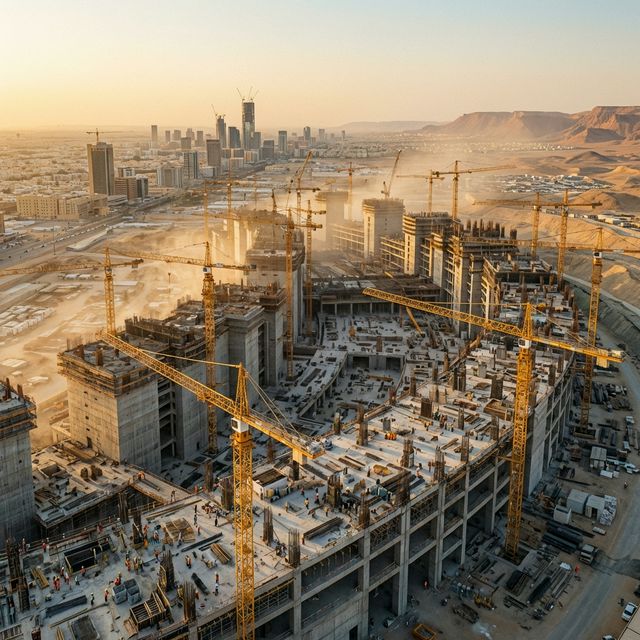
Factory-built components promise speed and consistency. Where that promise holds in the Saudi market and where conventional building still wins.
Prefabrication is presented as the future of construction and sold as a straightforward improvement. It is genuinely better at some things and genuinely worse at others, and which matters depends far more on your project type than on the general argument.
Prefabricated and modular at a glance
Components or volumetric modules manufactured off site under factory conditions, then transported and assembled, with much of the work completed before delivery.
Conventional construction at a glance
Built in place with concrete, blockwork and traditional trades, which remains the default for most residential and commercial work in the market.
Programme
Prefabricated and modular: Faster once manufacturing begins, because factory work and site preparation happen in parallel. The gain is real but front-loaded by design time.
Conventional construction: Sequential by nature. Each stage largely waits for the previous one, though a well-planned floor cycle recovers much of the difference.
Design freedom
Prefabricated and modular: Constrained by module dimensions, transport limits and the manufacturer's system. Changes after manufacturing starts are expensive or impossible.
Conventional construction: Almost unconstrained, which is why bespoke residential work remains conventional.
Quality consistency
Prefabricated and modular: Higher and more repeatable, because work happens under controlled conditions with fixed jigs and supervision.
Conventional construction: Dependent on the crews assigned and the supervision applied, which varies more between projects and between floors.
Cost profile
Prefabricated and modular: Higher design and mobilisation costs, lower marginal cost per repeated unit. It rewards volume.
Conventional construction: Lower entry cost, with cost roughly proportional to quantity. It does not reward repetition as strongly.
Risk concentration
Prefabricated and modular: Concentrated in the manufacturer and in transport. A single supplier problem can stop everything.
Conventional construction: Distributed across many trades and suppliers, so problems are more frequent but rarely total.
When prefabricated and modular wins
- The design repeats, as in labour accommodation, schools or similar unit-based buildings.
- Programme certainty matters more than design flexibility.
- Site access and working conditions are difficult or remote.
- Consistent quality across many identical units is a priority.
When conventional construction wins
- The design is bespoke, as in most private villas.
- Changes during construction are likely and need to be accommodated.
- The local supply chain and trade base are well established for the building type.
- The plot is constrained for crane access or large deliveries.
How to decide
Choose prefabrication when the design repeats enough to amortise the setup and when programme certainty is worth losing flexibility. Choose conventional construction for bespoke, one-off buildings, and for any project where the design is not fully resolved before work must begin.
Before choosing prefabrication, verify three things: transport access to the site for the module size, the manufacturer's completed projects and capacity, and what the contract says happens if the factory is delayed. That last point is where the programme advantage is either protected or lost.
If you are preparing to build, Domira can review your drawings, scope and contractor offers before you commit, and supervise delivery against the programme and specification you agreed.
Frequently Asked Questions
Is prefabricated construction cheaper?
Not automatically. It becomes cheaper when repetition is high enough to spread the design and setup cost, and when the programme saving has real value, such as earlier rental income. For a single villa, the economics rarely favour it.
Do prefabricated buildings perform worse in hot climates?
Performance depends on the specification of the envelope, not on where it was assembled. A well-specified prefabricated panel can outperform poorly executed conventional construction, and the reverse is equally true. Ask for the thermal specification and the tested performance rather than judging by method.
Can the two methods be combined?
Yes, and hybrid approaches are common: a conventional structure with prefabricated bathroom pods, facade panels or joinery. This captures consistency where repetition exists while keeping flexibility in the parts that vary.
Have a Property Question?
Domira can help you navigate property, financing and investment decisions in Saudi Arabia. Speak with our team for an initial consultation.
