
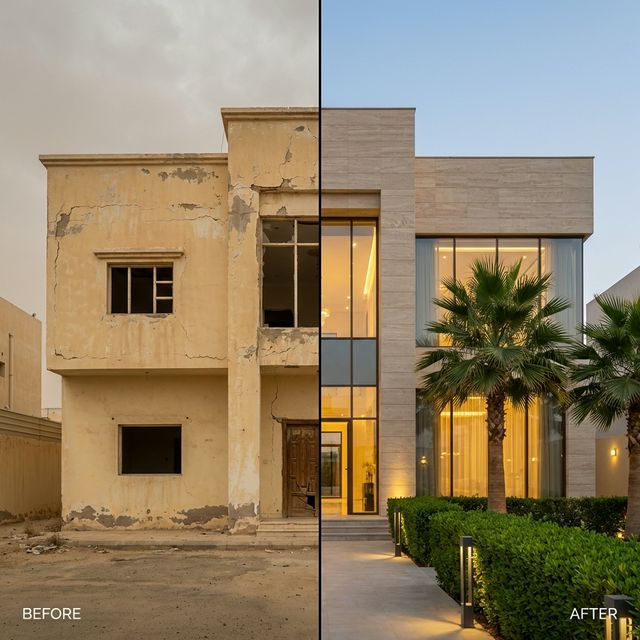
A villa has perhaps forty maintainable items. Listing them, setting a frequency for each and assigning an owner turns surprise repairs into predictable work.
A villa running on reactive maintenance costs more than one running on a schedule, because every failure arrives as an emergency and emergencies are priced accordingly. The schedule itself is simple to build: list what can fail, decide how often each item needs attention, note who does it, and keep a record. The work below takes a weekend to set up and then runs itself.
Before stage one
Start when you can walk the property and open every plant cupboard, roof hatch and inspection chamber. You need to see what is actually installed rather than what the handover documents claim, because equipment is substituted during construction and added afterwards. A villa that has changed hands may contain several generations of equipment that nobody has catalogued.
- Confirm you can access the roof, the plant area, the water tanks and every distribution board safely.
- Gather whatever documentation exists, including manuals, warranties and previous service reports.
- Note the age of the property and of any major equipment that has been replaced since.
- Identify which items are under warranty and what that warranty requires of you.
- Decide who will hold the schedule, because an unowned schedule stops being followed within a year.
Stage 1: Build the asset list
Walk the property and write down everything that can fail and cost money: air conditioning units indoor and outdoor, water heaters, water tanks and pumps, the pool plant if present, the irrigation controller and valves, the gate motor, the distribution boards, the lighting controls, smoke alarms, the roof covering, external sealant joints, rainwater outlets, drainage chambers and the generator if there is one. Record the make, model, location and installation date where you can find it.
- Deliverable: A single asset list with make, model, location and age for each item.
- Owner: The owner, or a surveyor engaged for the walk.
- Approval gate: Nothing is missing from the list that could cost more than a few thousand riyals to fix.
Stage 2: Assign a frequency to each item
Frequencies come from three sources: the manufacturer recommendation, the local environment and your own experience of the property. Air conditioning filters in a dusty area need attention more often than a manual written for a temperate climate suggests. Water tanks need periodic cleaning. Sealant joints need an annual look. Drainage chambers need checking before the wet season rather than after the first blockage.
- Deliverable: The asset list with a frequency against every item, justified in a short note.
- Owner: The owner, with advice from the service providers already visiting.
- Approval gate: Every item has a frequency, including items whose frequency is a yearly visual check.
Stage 3: Group the work into visits
Twenty items each needing attention on their own date is unmanageable. Group them into a small number of visits: a pre summer visit covering cooling, a post summer visit covering drainage and the roof before any rain, a quarterly visit for the pool and water systems, and an annual electrical and safety check. Grouping reduces call out charges and makes the schedule something a household can actually follow.
- Deliverable: A calendar of four to six grouped visits with the task list attached to each.
- Owner: The owner, working with the chosen contractors.
- Approval gate: Every item on the asset list appears in at least one grouped visit.
Stage 4: Choose and brief the providers
Decide which visits go to a contracted provider and which the household handles. Give each provider the task list for their visit rather than asking for a general service, and require a report that records measured values rather than a signature confirming attendance. A provider who knows you read the reports behaves differently from one who assumes nobody will.
- Deliverable: A written scope per provider with the required report format agreed.
- Owner: The owner, with quotations compared against the same task list.
- Approval gate: A sample report seen and accepted before the first visit is booked.
Stage 5: Add the seasonal checks the household performs
Some tasks need no contractor: testing smoke alarms, clearing rainwater outlets of wind blown debris, checking for drips under sinks, watching the water meter for unexplained consumption, running the gate manual release once a year so everyone knows how it works, and looking at the roof after a storm. These are the checks that catch a small problem before it becomes a contractor visit.
- Deliverable: A short household checklist with reminders set in a calendar.
- Owner: A named household member rather than everybody in general.
- Approval gate: The checklist fits on one page and takes under an hour each time.
Stage 6: Keep a running record
Record each visit, what was found, what was replaced and what was deferred. Over two or three years this record becomes genuinely valuable: it shows which equipment is consuming the budget, it supports a warranty claim, and it is evidence of care when the property is sold or insured. A folder of dated reports is enough; the format matters far less than the habit.
- Deliverable: A maintenance file holding every report, invoice and warranty document.
- Owner: The owner, with a single storage location known to the household.
- Approval gate: Any report from the last three years can be found within a few minutes.
Stage 7: Review the plan annually
Once a year, read the record and change the plan. Items that failed between visits need a shorter interval. Items that have been checked three times with nothing found may need a longer one. Equipment approaching the end of its life should move from the maintenance budget to a replacement plan, so the cost arrives as a decision rather than as an emergency in August.
- Deliverable: A revised schedule with the reasons for each change noted.
- Owner: The owner, taking an hour at the same point each year.
- Approval gate: At least one frequency changes, because an unchanged plan usually means the record was not read.
Handovers between stages
The point at which villa maintenance plans usually collapse is a change of occupant or a change of service provider, because the schedule lives in one person head rather than in a document. Keep the asset list and the calendar in a form that can be handed over. The second weak point is the gap between a contractor report that says a part is nearing failure and anybody acting on it, so put every recommendation into the next visit or decide explicitly to accept the risk.
How you know it is finished
The plan is working when nothing significant fails without warning, when each contractor visit is against a written task list, when you can produce a dated history for every major item, and when the annual review changes something. Requirements for items such as electrical safety verification and water storage hygiene are set by the relevant authorities and are reviewed from time to time, so confirm the current expectations rather than assuming the practice you inherited is still correct.
Domira works on buildings that already exist: surveying what is installed, specifying the systems that have to be replaced, and running maintenance and refurbishment work around the people using the property. Tell Domira which asset you are responsible for and we will say what we would inspect first.
Frequently Asked Questions
What maintenance does a villa in Saudi Arabia actually need each year?
In most villas the recurring items are air conditioning servicing before and during the hot season, water tank cleaning and pump checks, drainage and rainwater outlet clearing, external sealant and roof inspection, electrical safety verification, pool plant servicing where there is a pool, and irrigation system checks. The exact list depends on what is installed, which is why the asset walk comes first.
How often should villa air conditioning be serviced?
More often than a manual written for a temperate climate suggests, because dust loading is higher and run hours are long. Filters typically need attention several times through the cooling season, while a fuller service covering coils, drains, refrigerant condition and electrical connections is usually annual before the season starts. Adjust the interval based on what each service actually finds.
Is a maintenance contract worth it for a single villa?
It depends on whether the contract is a defined task list or a vague promise of attendance. A contract that specifies tasks, frequencies and a report format, at a price you compared across bidders, usually costs less than reactive callouts and gives you a record. A contract that only guarantees a response time may be worth less than keeping two reliable numbers in your phone.
Have a Property Question?
Domira can help you navigate property, financing and investment decisions in Saudi Arabia. Speak with our team for an initial consultation.
