Lighting is usually a shopping decision made after the wiring is fixed. Reversing that order changes the result.
Lighting is the element most responsible for how a house feels at night and the one most often reduced to a symmetrical grid of ceiling points. Planning it properly costs nothing extra during first fix and cannot be done afterwards.
Before stage one
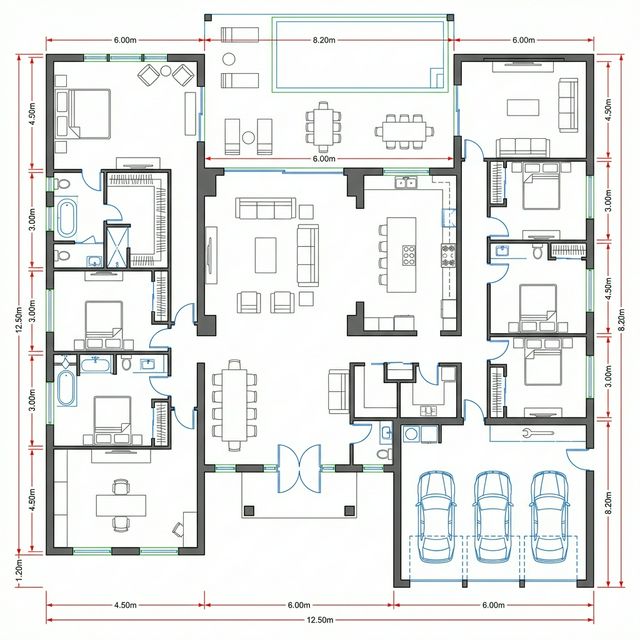
Lighting design should begin before electrical first fix, alongside the furniture layout, because positions depend on where activities happen rather than on room geometry.
- A furniture layout for each room.
- An understanding of the activities in each space and when they occur.
- Ceiling construction known, since it determines what fittings are possible.
- Control preferences: how many switching zones and whether dimming is wanted.
Stage 1: Identify tasks and moods
For each room, list what people do there and what quality of light each activity needs.
- Deliverable: A room by room description of lighting requirements.
- Owner: Owner with the designer.
- Approval gate: Requirements described before any fitting is selected.
Stage 2: Layer the light
Plan three layers: general illumination, task light where activities happen and accent light for interest.
- Deliverable: A layered lighting concept per room.
- Owner: Designer.
- Approval gate: No room relies on a single central fitting for all purposes.
Stage 3: Position against furniture
Place fittings relative to where furniture and activities are, not relative to the room's centre.
- Deliverable: A lighting layout overlaid on the furniture plan.
- Owner: Designer.
- Approval gate: Every task position has light where the task happens.
Stage 4: Plan switching and control
Define zones and switch positions so that light can be adjusted for different uses and times.
- Deliverable: A switching schedule with zones and positions.
- Owner: Designer with the electrical engineer.
- Approval gate: Switches at every entry point, with zones that make sense for how rooms are used.
Stage 5: Specify fittings and lamps
Select fittings suited to their positions and specify colour temperature and output consistently.
- Deliverable: A fitting schedule with lamp specifications.
- Owner: Owner with the designer.
- Approval gate: Colour temperature consistent within each space and appropriate to its use.
Stage 6: Coordinate with ceilings and structure
Confirm that every fitting can be installed where shown, given the ceiling construction and any structure above.
- Deliverable: A coordinated lighting layout.
- Owner: Designer with the contractor.
- Approval gate: Coordination confirmed before ceilings are closed.
Handovers between stages
The failure point is between the lighting layout and electrical first fix. Where the layout is not ready, the electrician positions points reasonably, and those positions become permanent within days.
How you know it is finished
The lighting is well planned when each activity has appropriate light, switching suits how the rooms are used, colour temperature is consistent, and nothing was positioned by default because a decision was not ready.
If you are starting a design, Domira can help you write the brief, review the drawings and keep the design aligned with the budget before it reaches a contractor.
Frequently Asked Questions
How many lighting circuits does a room need?
Enough that the light can be adjusted for different uses: a room used for both gathering and quiet activity needs at least two. The number follows from the uses rather than from the room's size.
What colour temperature should I use?
Consistency within a space matters more than the specific choice, and warmer light generally suits living and sleeping areas while cooler light suits task areas. Mixing temperatures within one room is the error that most reliably makes lighting look wrong.
Is a lighting designer necessary for a house?
For a straightforward house, a thoughtful architect or interior designer working from the furniture layout usually suffices. For larger or more complex projects, or where lighting is central to the character, a specialist adds a great deal for a modest fee.
Have a Property Question?
Domira can help you navigate property, financing and investment decisions in Saudi Arabia. Speak with our team for an initial consultation.