
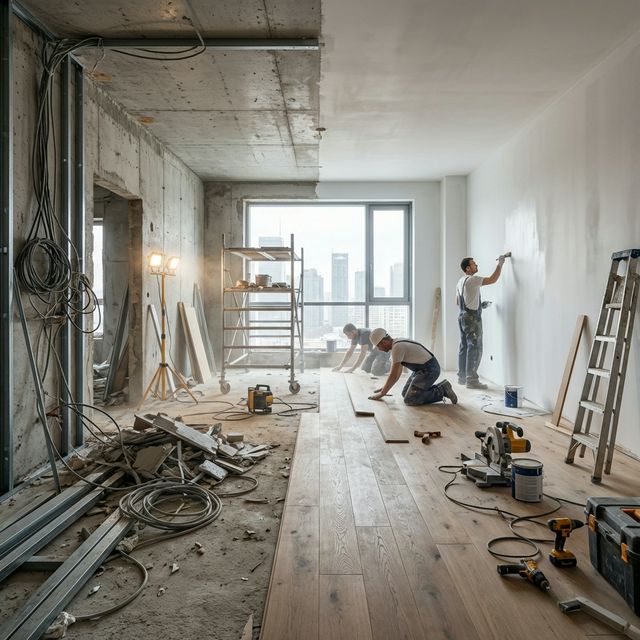
An illustrative calculation covering energy saved, cooling load avoided, maintenance reduced and the disruption cost of relamping an occupied office.
A lighting retrofit is one of the few building upgrades where the arithmetic is simple enough to verify yourself. Energy saved is the wattage difference multiplied by operating hours. Cooling load avoided is a real secondary saving in a hot climate. Maintenance saved is the relamping you no longer do. The example below works through all three with illustrative figures to demonstrate the method.
The situation
An owner of a six floor office building in Jeddah is considering replacing the existing fluorescent lighting throughout the common areas and the let floors. The building is occupied, so works have to happen outside working hours. The question is whether the retrofit pays for itself within a period the owner finds acceptable, and what the answer is sensitive to.
Assumptions (illustrative)
- Existing fittings: 1,200 luminaires at 72 watts each including control gear.
- Replacement fittings: 1,200 LED luminaires at 32 watts each, illustrative supply cost SAR 210 each.
- Installation cost out of hours: illustrative SAR 95 per fitting including disposal of the old unit.
- Operating hours: 3,100 hours per year across the mix of let floors and common areas.
- Illustrative electricity cost: SAR 0.32 per kilowatt hour for this customer category.
- Existing relamping: illustrative SAR 34,000 per year in tubes, control gear and labour.
Step 1: Calculate the load reduction
Existing connected lighting load is 1,200 multiplied by 72 watts, which is 86.4 kW. The replacement load is 1,200 multiplied by 32 watts, which is 38.4 kW. The reduction is 48 kW.
This is the headline figure every supplier quotes. On its own it says nothing about money, because the value depends entirely on how many hours those fittings actually run.
Step 2: Convert to annual energy and cost saved
48 kW multiplied by 3,100 hours gives 148,800 kWh saved per year. At SAR 0.32 per kWh that is SAR 47,616 a year.
Operating hours matter more than wattage. The same fittings in a building that runs its lights 1,200 hours a year would save under SAR 19,000, and the project would look very different.
Step 3: Add the avoided cooling load
Removed lighting heat of 48 kW occurs mostly during cooled hours. Assuming 70 per cent of the operating hours are cooled and a cooling system coefficient of performance of 3.2, the avoided cooling energy is 48 multiplied by 3,100 multiplied by 0.70 divided by 3.2, which is 32,550 kWh, worth about SAR 10,416 a year.
In a hot climate this secondary saving is genuine and frequently left out of supplier proposals. It also slightly reduces the load on the chillers, which matters if they are running near capacity.
Step 4: Add the maintenance saving
Relamping of SAR 34,000 a year largely disappears during the warranty period. Allowing SAR 6,000 a year for occasional LED driver failures, the net maintenance saving is SAR 28,000 a year.
Maintenance savings are often the most reliable part of the case, because they are an existing invoiced cost rather than a modelled one. They also remove out of hours access work in tenanted areas.
Step 5: Total the project cost
Supply at 1,200 multiplied by SAR 210 is SAR 252,000. Installation at 1,200 multiplied by SAR 95 is SAR 114,000. Total capital cost is SAR 366,000.
Out of hours installation in an occupied building adds materially to the cost. A vacant building would reduce this line and shorten the payback by several months.
Step 6: Calculate simple payback
Total annual saving is 47,616 plus 10,416 plus 28,000, which is SAR 86,032. Payback is 366,000 divided by 86,032, which is 4.25 years.
Just over four years, with roughly 45 per cent of the saving coming from energy, 12 per cent from cooling and 33 per cent from maintenance. If the maintenance line had been excluded, as it often is, the payback would have appeared as 6.3 years.
What changes the answer
- If operating hours fall to 2,200, the energy and cooling savings drop by roughly 29 per cent and payback extends beyond five and a half years.
- If the electricity price for this category changes, the energy and cooling lines move proportionally while maintenance stays fixed.
- If the existing fittings can be retrofitted with lamps rather than replaced entirely, capital cost falls sharply but control gear compatibility must be verified fitting by fitting.
- If lighting controls such as occupancy sensing are added in low traffic areas, savings rise but capital cost and commissioning effort rise with them.
- If the LED drivers fail earlier than warranted, the maintenance saving erodes and the case depends more heavily on the energy line.
What the numbers tell you
- Operating hours drive the result more than the wattage difference, so measure them rather than assuming.
- Include the avoided cooling load, because in this climate it is a genuine and sizeable part of the case.
- Count the maintenance saving, since it is based on real invoices and is usually the most dependable component.
- Price out of hours working honestly, as it can add a third to the installation line in an occupied building.
- Check warranty terms on drivers, because the maintenance saving disappears if early failures are not covered.
Limits of this example
Every figure above is an illustrative assumption used to show the method, not a quote, valuation or market rate. Costs, rates, fees and regulations change and must be confirmed with the relevant authority, lender or supplier before you commit.
Domira works on buildings that already exist: surveying what is installed, specifying the systems that have to be replaced, and running maintenance and refurbishment work around the people using the property. Tell Domira which asset you are responsible for and we will say what we would inspect first.
Frequently Asked Questions
Is it cheaper to replace whole light fittings or just the lamps?
Retrofit lamps are cheaper to buy and install but depend on the existing control gear being compatible and in good condition, and they inherit the optical performance of an old fitting. Complete replacement costs more and resets the asset life, the warranty and the light distribution. Survey a sample of the existing fittings before choosing, because mixed installations often need both approaches.
How much does lighting contribute to a building cooling load?
Every watt of lighting inside a cooled space becomes heat the cooling system has to remove, so reducing lighting load reduces cooling energy as well. The size of the effect depends on the operating hours that coincide with cooling and the efficiency of the cooling plant. Include it in the calculation, but derive it from your own hours and plant efficiency rather than a rule of thumb.
Should a lighting retrofit be done floor by floor?
In an occupied building, yes in most cases. Working floor by floor out of hours limits disruption, lets you verify the first floor result before committing to the rest, and gives the supplier a chance to correct colour temperature or output problems on a small scale. It costs slightly more in mobilisation and is usually worth it.
Have a Property Question?
Domira can help you navigate property, financing and investment decisions in Saudi Arabia. Speak with our team for an initial consultation.
