
Planting is the cheap part. Soil, drainage, irrigation and the water it needs are what decide whether a Saudi garden survives its second summer.
A garden in this climate is an engineered system, not a planting plan. The plants are a modest part of the cost; the substantial parts are the soil that has to be imported and improved, the drainage that stops water sitting against the building, the irrigation that keeps everything alive through summer, and the water and labour that the garden consumes every year after handover. This breakdown separates the capital lines from the running commitment.
What this number does and does not include
This covers soft landscape and irrigation: ground preparation, soil, drainage within planted areas, planting, turf, irrigation infrastructure and controls, and the first period of establishment. It excludes hard landscape such as drives and paving, boundary walls, pools and water features, and the main water supply and storage, which are priced elsewhere. It assumes a plot where construction has finished and the soil has been disturbed.
Removing construction material and preparing the ground
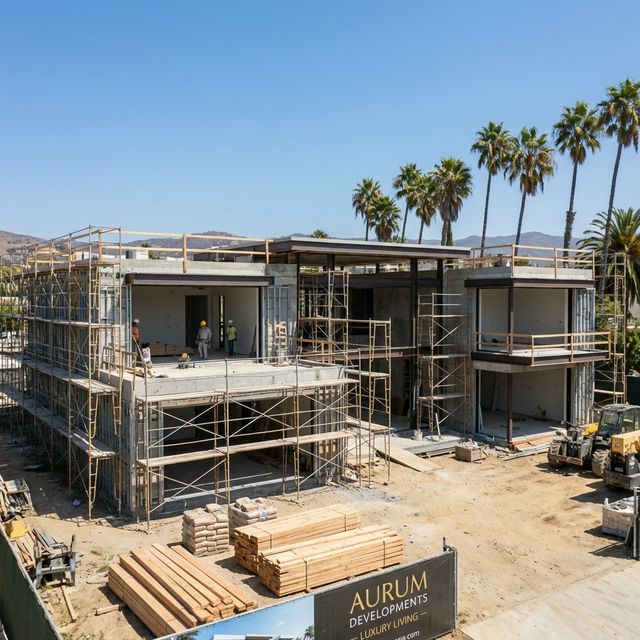
The ground around a new building is a construction site: compacted by plant, mixed with rubble, cement washings, offcuts and sometimes buried waste. Planting into it fails. Preparation means excavating the contaminated material to a workable depth, breaking up compaction and removing debris, and it is the first and most underestimated cost.
- Pushes it up: Heavy compaction from plant movements, buried construction waste and cement contaminated ground.
- Brings it down: Protecting planned garden areas from traffic and storage during construction, which costs almost nothing to plan.
- How to control it: Fence the garden areas during the build, and inspect and test the ground before any soil is imported.
Imported soil and improvement
Planting depth and soil quality determine what will grow. Depths differ between turf, shrubs and trees, and a tree pit is a substantial excavation and backfill in its own right. Soil has to be tested, because salinity and high alkalinity are common and will kill a planting scheme regardless of irrigation.
- Pushes it up: Large planted areas, mature trees requiring deep pits, and poor local soil needing significant improvement.
- Brings it down: Designing with planting that suits the available soil and reducing the area of deep bed planting.
- How to control it: Test the imported soil for salinity, alkalinity and drainage before it is spread, and record the result.
Drainage within planted areas
Irrigated beds against a building put water into the ground next to a structure every day. Without drainage, that water accumulates, saturates the backfill, loads the basement waterproofing and in some soils causes movement. Planted areas need subsurface drainage with an outfall, and beds adjacent to walls need particular care.
- Pushes it up: Low permeability soil, beds at a lower level than surroundings and planting tight against the building.
- Brings it down: Setting bed levels so water drains away naturally and keeping heavily irrigated planting away from the walls.
- How to control it: Require a drainage layout for planted areas with a confirmed outfall, and check bed levels before soil is placed.
Irrigation mainline, valves and zoning
The buried infrastructure is the part that cannot be changed later: mains, valve boxes, wiring to solenoids and the division of the garden into zones. Zoning matters because a lawn, a shrub bed and trees need different quantities and frequencies, and a single zone waters everything to suit the thirstiest plant.
- Pushes it up: A large plot, many separate planting types, long runs and pressure requirements that need boosting.
- Brings it down: Grouping planting by water demand so fewer zones serve the scheme properly.
- How to control it: Approve an irrigation layout with zones matched to planting types, and survey the buried lines before paving or soil placement.
Emitters, drip line and sprinklers
The delivery method decides how much water reaches the root and how much evaporates. Drip and subsurface lines deliver water efficiently to beds and trees; sprinklers suit turf but lose water to evaporation and wind. Emitters also block, particularly with hard water and dust, so filtration and accessibility matter.
- Pushes it up: Large turf areas needing sprinkler coverage, and high emitter counts across detailed planting.
- Brings it down: Reducing turf area, which is the single biggest reduction available in both capital and water cost.
- How to control it: Specify filtration suited to the water quality and keep valve boxes and filters accessible for cleaning.
Controller, sensors and water source
The controller decides the schedule, and a sensible one adjusts for the season rather than running the same programme in January and July. Rain or moisture sensing avoids irrigating after rain. The water source also matters: municipal supply, tanker delivery or treated greywater each carry different cost and quality implications.
- Pushes it up: Multiple zones, remote monitoring, treated water systems and backflow prevention requirements.
- Brings it down: A straightforward controller with seasonal adjustment rather than a complex system nobody reprogrammes.
- How to control it: Hand over the programme in writing with seasonal settings, and confirm the backflow prevention arrangement.
Plants, trees and turf
The visible item, and usually a smaller share of the total than owners expect. Cost is driven by maturity more than by species: a large tree costs many times a young one, and it also needs a bigger pit, staking and far more attention through establishment. Species selection determines the water bill for decades.
- Pushes it up: Mature specimen trees, large turf areas and species that are not suited to the climate.
- Brings it down: Planting younger stock that establishes better, and selecting species adapted to heat and salinity.
- How to control it: Approve the planting schedule against water demand and maintenance, not only against appearance.
Establishment and ongoing maintenance
A garden is not finished when it is planted. The establishment period needs careful watering, monitoring and replacement of losses, and after that it needs continuous mowing, pruning, feeding, pest control, irrigation repairs and water. This is a recurring commitment that should be budgeted from the first year rather than discovered.
- Pushes it up: Large turf areas, formal planting requiring frequent trimming and schemes with high water demand.
- Brings it down: A planting design chosen for low intervention, with gravel or hard surfaces where nothing needs to grow.
- How to control it: Agree an establishment period with replacement obligations, and budget annual maintenance and water separately from the build.
Costs that never appear on the first page
- Replacing plants that died during establishment because handover and occupation were delayed.
- Repairing irrigation lines cut by a later trade working in the garden.
- Water consumption that proves far higher than expected once summer arrives.
- Remedial drainage after beds adjacent to the building caused damp or basement leakage.
- Flushing and replacing blocked emitters where filtration was inadequate for the water quality.
- Reprogramming or replacing a controller that nobody was shown how to operate.
Keeping the budget honest
Budget the garden as a capital cost plus an annual commitment, and make the annual figure explicit before the design is approved, because it is the number that determines whether the garden still looks like the drawing in three years. Within the capital cost, protect soil preparation, drainage and irrigation infrastructure and treat plant maturity as the adjustable item. A modest planting scheme in properly prepared ground with good irrigation will outperform an ambitious scheme in construction spoil every time.
- During construction, confirming garden areas are protected from traffic and storage.
- Before soil is imported, with the ground inspected and the soil tested.
- At the irrigation layout, checking zoning against planting water demand.
- Before paving or soil placement, surveying all buried irrigation and drainage lines.
- At the end of the establishment period, assessing losses and the actual water consumption.
Domira builds and supervises projects across Saudi Arabia, and this is the level of detail its site teams work at. Send the drawings or the site, and Domira will tell you what the specification has to say before anyone prices it.
Frequently Asked Questions
Why do new gardens fail in their second summer?
Because the first summer is covered by intensive establishment watering and attention, and the second is not. The usual underlying causes are planting into compacted construction ground, insufficient soil depth, irrigation zoning that waters everything on one schedule, blocked emitters and species chosen for appearance rather than for heat and salinity tolerance.
Is drip irrigation better than sprinklers?
For beds, shrubs and trees, drip and subsurface lines deliver water close to the root with far less evaporation, which matters a great deal in this climate. Sprinklers remain the practical option for turf but lose water to evaporation and wind and are best run outside the hottest hours. Many gardens use both, zoned separately.
How much soil depth does planting need?
It varies by plant type, with turf needing the least, shrubs more and trees requiring a substantial pit rather than a layer. Depths should come from the landscape design for your scheme. Just as important is what sits beneath the soil, since a layer of good soil over compacted construction ground drains badly and roots cannot penetrate it.
Can treated water be used for irrigation in Saudi Arabia?
Treated water is used for irrigation in various contexts, and the rules on which water may be used for what, along with the treatment, testing and backflow prevention required, are set by the relevant authorities and differ by locality and application. Confirm the current requirements before designing a system around it, and have the water quality tested against the needs of your planting.
Have a Property Question?
Domira can help you navigate property, financing and investment decisions in Saudi Arabia. Speak with our team for an initial consultation.
