
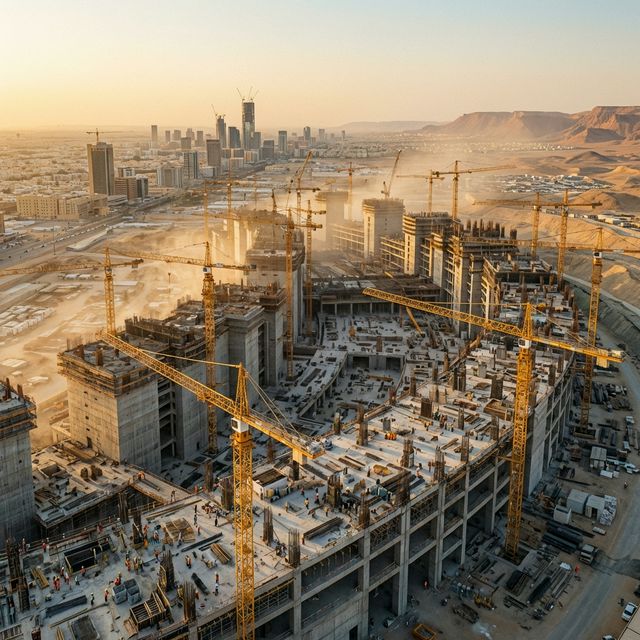
Safety responsibility on a construction site is allocated by contract, by role and by law at the same time. Six assumptions that leave somebody exposed.
On a building site the contractor controls the work, the supervising engineer observes it, the subcontractors perform it and the owner pays for it. Safety duties do not follow that hierarchy neatly. They arise from the contract, from the role each party actually performs and from the law, and the assumptions below cause parties to believe they are covered when they are not.
How to test a claim like this
Test any assumption about safety responsibility with two questions. Who actually controls the activity or the place where the risk arises? And what does the contract say about the obligation, the plan, the reporting and the consequences of a failure? Where control and contractual responsibility sit with different parties, there is an exposure, and it should be resolved before work starts rather than after an incident. Requirements in this area come from the applicable regulations and from the authorities that enforce them, and they change, so confirm the current position rather than relying on practice from an earlier project.
Myth 1: Safety is entirely the main contractor problem once it has possession of the site.
Reality: The main contractor normally carries the primary operational duty, and that is a substantial allocation. It does not follow that every other party is unexposed. An owner that instructs work in a way that forces an unsafe method, a designer that specifies a detail that cannot be built safely, or a supervising engineer that observes an unsafe practice and says nothing, each occupies a position that is not simply neutral.
How to check it yourself: Record what your own role actually involves on this project, then ask a licensed adviser what obligations attach to that role under the applicable requirements.
Myth 2: A safety plan in the tender submission means a safety system exists.
Reality: A plan is a document, and documents are frequently generic. A system is a plan plus the people to run it, the training records, the method statements and risk assessments for the actual activities, the permit regime, the inductions, the inspections and the corrective actions. Projects routinely accept a document and never check whether anything behind it exists.
How to check it yourself: Ask to see the training records, three activity specific method statements and the last month of inspection reports. A generic plan cannot produce those.
Myth 3: Subcontractors look after their own people, so their safety is their own affair.
Reality: Subcontractors do carry duties for their own workforce, but on a site they work inside an environment the main contractor controls: access, scaffolding, power, lifting, excavations and the interaction between trades. Most serious site incidents involve one trade affected by another activity, which is precisely the area a single party has to coordinate.
How to check it yourself: Confirm who coordinates between trades, how permits are issued for high risk activities and how one subcontractor is stopped from endangering another.
Myth 4: Workforce administration is unrelated to site safety.
Reality: They are closely connected in practice. Worker registration and insurance arrangements administered through bodies such as GOSI and Qiwa, accommodation and transport conditions, working hours in heat and the use of labour supplied by third parties all affect who is on site, how fit they are to work and what happens after an incident. Requirements in this area are revised periodically.
How to check it yourself: Ask how every worker on site is engaged and registered, and confirm with the relevant authorities what the current obligations are for your situation.
Myth 5: A good safety record means low risk on this project.
Reality: A record describes past projects, often delivered by different people in different conditions. Risk on your project comes from your activities: the depth of the excavation, the height of the facade, the lifting operations, the hot works, the confined spaces and the interaction with an occupied building or a live road. A strong corporate record with no plan for your specific hazards is not reassurance.
How to check it yourself: List the five highest risk activities on your project and ask for the specific method statement and competence evidence for each.
Myth 6: Safety spending is a cost that can be trimmed when the programme tightens.
Reality: The costs that get trimmed are supervision ratios, inductions, scaffolding standards and the time to do a task properly, which are the controls rather than the paperwork. The exposure after an incident includes stoppage, investigation, liability and reputational consequences, none of which are proportionate to the saving. Insurance responds to some of it and not to all of it.
How to check it yourself: Review the safety resourcing whenever the programme is compressed, and record the decision, because compression is exactly when incidents cluster.
What this changes in your decision
- Write down what your own role on the project actually involves, and get advice on the obligations attaching to it.
- Test the safety system behind the plan by asking for training records, activity specific method statements and recent inspection reports.
- Confirm who coordinates between trades and how permits for high risk activities are issued.
- Ask how every worker on site is engaged and registered, and verify the current requirements with the relevant authorities.
- Treat programme compression as a trigger to review safety resourcing rather than a reason to reduce it.
Domira builds and supervises projects across Saudi Arabia, and the commercial discipline above is how its projects stay inside their budget and their programme. Send the drawings, the contract or the site and Domira will tell you where the risk actually sits.
Frequently Asked Questions
How is safety responsibility split between owner, contractor and subcontractor?
The main contractor normally carries the primary operational duty for the site it controls, with subcontractors responsible for their own activities and workforce, and the owner and designer carrying obligations connected to their own roles and decisions. The precise allocation comes from the contract and from the applicable regulations, which are enforced by the relevant authorities and change over time, so confirm the current position with a licensed adviser.
What should a construction safety plan actually contain?
The organisation and named responsibilities, the hazard identification and risk assessments for the actual activities, method statements for high risk work, the permit to work regime, induction and training arrangements with records, inspection and audit frequencies, emergency and first aid arrangements, incident reporting procedures, and the corrective action process. A plan with none of the project specific content is a template.
Can an owner be exposed if a contractor has an accident on site?
Exposure depends on the facts, the contract and the applicable law, and an owner that instructs methods, controls access or retains responsibilities is in a different position from one that does not. Insurance arrangements also matter, and the contract allocation and the policy wording need to be consistent. Because the answer is specific to the circumstances, it should come from a licensed legal adviser rather than from a general rule.
Have a Property Question?
Domira can help you navigate property, financing and investment decisions in Saudi Arabia. Speak with our team for an initial consultation.
