
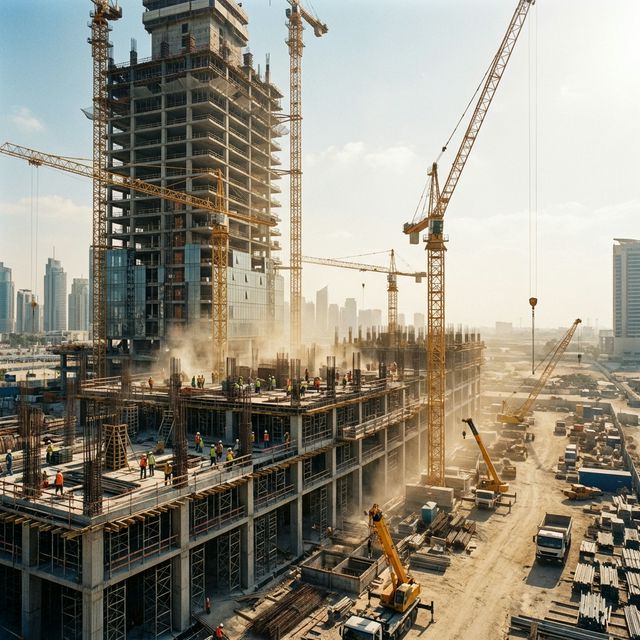
Loose sand, sabkha, fill and groundwater turn a simple dig into the riskiest week of the build. The errors below cause collapses, damaged neighbours and foundations that never sit right.
Excavation looks like the cheapest activity on the site and is routinely the most dangerous. In loose sand, in uncontrolled fill from a previous demolition, in sabkha and anywhere the water table is close, the sides of an open cut do not stay where the machine left them. The mistakes below are the ones that recur: they come from treating the dig as earthmoving rather than as a temporary structure that has to stand up until the foundation is built inside it.
Why these keep happening
Each of these failures starts from the same assumption, that the ground will behave the way it looked on the day the excavator arrived. Sand that stands vertically in the morning slumps after a night of moisture change. Fill that carries a wheeled machine collapses under a vibrating one. A ground investigation report answers most of these questions before the first bucket moves, which is exactly why the report needs to be read by the person planning the dig and not filed by the person who commissioned it.
1. Digging without reading the ground investigation
The borehole log tells you the layers, their density, where water was struck and whether chemically aggressive conditions exist. Site teams often work from the foundation drawing alone, which shows the finished shape but says nothing about what the sides of the hole will do. The result is a method chosen for a soil that is not there.
- Avoid it by: Issue the ground report to the excavation subcontractor as a contract document and ask for a method statement that refers to it by layer.
- Proof it is closed: A written excavation method statement naming the strata, the batter angle or support system chosen, and the water assumption.
What it costs you: A collapse that has to be re-excavated, re-levelled and often re-compacted, plus the delay to every following trade.
2. Battering the sides at an angle the soil cannot hold
An unsupported cut relies entirely on the slope of its sides. The safe angle depends on the material, its moisture and how long the cut stays open, and dry loose sand holds a far shallower slope than most people assume. Steepening the batter to save space or spoil removal is the most common reason a side comes in.
- Avoid it by: Let the geotechnical engineer specify the batter for each stratum, and widen the excavation footprint in the layout rather than steepening it.
- Proof it is closed: A marked section drawing with the approved slope, checked on site with a level and a measuring staff.
What it costs you: Lost material, a wider hole than planned, extra backfill, and risk to anyone working below.
3. Stacking spoil and parking plant at the edge of the cut
Everything placed near the top of an excavation adds load exactly where the soil is least able to carry it. Spoil heaps, reinforcement bundles, a concrete truck waiting to discharge and the excavator itself all push the edge towards failure, and the failure arrives without warning.
- Avoid it by: Set and mark an exclusion zone from the crest for spoil and plant, and remove spoil from site rather than ringing the hole with it.
- Proof it is closed: Painted or taped crest lines on site and a spoil removal booking rather than a spoil mountain.
What it costs you: Collapse with plant in it, injury, and a claim that neither the owner nor the contractor wants to defend.
4. Ignoring groundwater until it appears in the hole
Water changes everything. It reduces the strength of the soil, it washes fines out of the base, it floats formwork and it makes compaction impossible. Teams that assume a dry dig because the surface is dry get surprised in coastal cities, near wadis, after irrigation leaks and anywhere a perched water table sits above a clay layer.
- Avoid it by: Plan dewatering and surface water control before the dig, including sump positions, pump capacity and a legal discharge route.
- Proof it is closed: A dry, firm formation inspected and approved immediately before blinding concrete is placed.
What it costs you: Standing water that softens the formation, a pour delayed, and a base that has to be removed and replaced.
5. Leaving the formation open to weather and traffic
The bottom of the excavation is the surface your building will sit on. Every day it stays open it dries, cracks, gets rained on, gets walked over and gets churned by a machine turning around in it. By the time reinforcement arrives it bears little resemblance to the material the engineer tested.
- Avoid it by: Sequence the dig so blinding concrete follows excavation closely, and keep plant off the final layer by digging the last portion with a flat bucket.
- Proof it is closed: A formation approval signed by the geotechnical or supervising engineer on the same day the blinding is cast.
What it costs you: Localised soft spots under footings, differential settlement later, and remedial excavation and replacement.
6. Treating a neighbouring structure as somebody else problem
An excavation close to an existing wall, building or road removes the lateral support that structure has relied on. Movement can appear as cracks days after the dig, and on a tight urban plot the neighbour is often only a metre away. The obligation to protect adjoining property does not disappear because the excavation is inside your boundary.
- Avoid it by: Survey the neighbour before you dig, design support for the face next to them, and monitor movement with targets rather than opinions.
- Proof it is closed: A monitoring record with readings from before, during and after the excavation.
What it costs you: Repair of the neighbouring structure, a stop to the works while it is negotiated, and a legal exposure the contract may not cover.
7. Backfilling with the material that came out of the hole
Excavated material is often perfectly reusable, and just as often it is not: it can contain demolition rubble, organic matter, gypsum rich fines or oversized lumps that cannot be compacted in layers. Reusing it without testing saves a few truck movements and creates a settlement problem under the slab or the drive.
- Avoid it by: Test the material for suitability, screen or reject what fails, and import approved fill where the test says so.
- Proof it is closed: Laboratory classification of the fill source plus field density tests on each compacted layer.
What it costs you: Sunken paving, cracked ground slabs, broken drainage runs and a repair that happens after handover.
A short check before you sign
- The ground investigation report is on site and the excavation method statement refers to its layers.
- A support system or batter angle is specified in writing for each face of the dig.
- Crest exclusion zones for spoil and plant are marked and respected.
- Dewatering capacity and a legal discharge route are arranged before water appears.
- Formation approval is a named hold point before blinding concrete.
- Adjoining structures have a pre-dig condition record and movement monitoring.
If it has already happened
If a face has already come in, stop work in and around the excavation before anything else. Have the geotechnical engineer inspect the failure and decide whether the remaining faces need support, because one collapse usually means the assumption was wrong everywhere. Re-excavate to firm material rather than tipping the fallen soil back into place, replace the base with compacted approved fill or lean concrete to the level the engineer specifies, and have the formation retested. Where a neighbouring structure has moved, bring in an independent engineer early; a structural opinion obtained before the argument hardens is far cheaper than one obtained afterwards.
Domira builds and supervises projects across Saudi Arabia, and this is the level of detail its site teams work at. Send the drawings or the site, and Domira will tell you what the specification has to say before anyone prices it.
Frequently Asked Questions
How deep can you excavate without shoring in sandy soil?
There is no universal depth. It depends on the soil type, its density and moisture, surcharge loads near the crest, how long the cut stays open and whether groundwater is present. Loose dry sand needs support or a very shallow slope at modest depths. The safe answer is a batter or support system specified by a geotechnical engineer for your specific borehole results, not a rule of thumb.
What is sabkha soil and why is it a problem for foundations?
Sabkha is a salt rich, often soft coastal deposit with variable strength and a high, aggressive water table. It can settle under load, it attacks concrete and steel chemically, and its properties change dramatically with moisture. Building on it usually means ground improvement, a deeper foundation or a raft designed for the conditions, with sulphate resisting measures confirmed by the structural and geotechnical engineers.
Who is responsible if excavation damages a neighbouring building?
Responsibility normally follows the party carrying out the works and the terms of the construction contract and its insurance, but an owner is rarely left untouched by a claim. Reduce the exposure with a pre-construction condition survey, a designed support scheme for faces near the neighbour, movement monitoring, and confirmation that the contractor insurance covers damage to adjoining property. Take advice from a licensed Saudi adviser on where liability sits in your contract.
Have a Property Question?
Domira can help you navigate property, financing and investment decisions in Saudi Arabia. Speak with our team for an initial consultation.
