Households change over twenty years and houses rarely do. The provisions that make later change possible, and what they cost now.
A house is designed for a household as it is on the day of the brief. Twenty years later the household is different, and the house has usually not moved at all. Some provisions made during design keep options open cheaply; others cost more than they return.
The situation
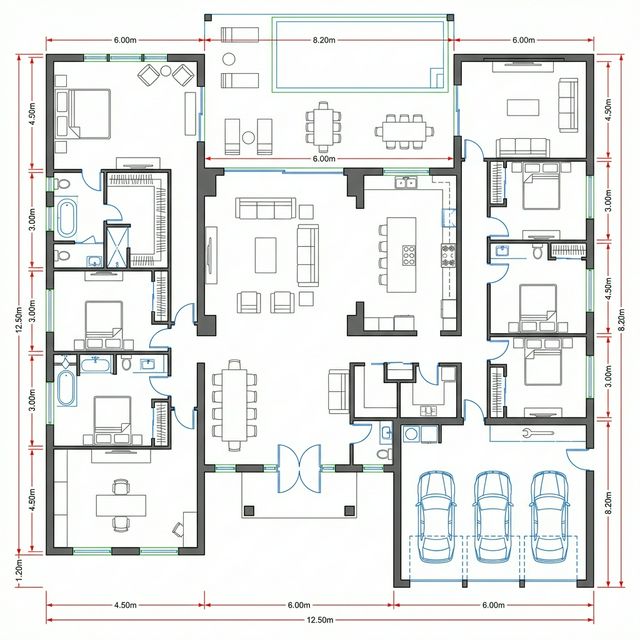
A family is designing a villa. The children are young, elderly parents may join in future, and the household may need to accommodate independent living for adult children.
Assumptions (illustrative)
- Built area: 400 square metres over two floors.
- Assumed cost of a ground floor room designed to function independently: SAR 30,000 above a standard bedroom.
- Assumed cost of a lift shaft built as storage now, converted later: SAR 45,000 now.
- Assumed cost of retrofitting a lift after construction: SAR 160,000.
- Assumed cost of roughing in services for a future kitchenette: SAR 8,000.
- Assumed cost of adding those services later: SAR 35,000.
- All figures are illustrative assumptions used to demonstrate the method.
Step 1: Ground floor accessible room
SAR 30,000 for a ground floor room with an adjacent accessible bathroom rather than a standard bedroom upstairs.
This provision serves elderly parents, illness or injury, and it is useful in more scenarios than any other item on the list.
Step 2: Lift shaft as future provision
SAR 45,000 now to build the shaft as storage, against SAR 160,000 to retrofit later, a difference of SAR 115,000.
The provision costs about a quarter of the later retrofit, and the space remains useful as storage until needed.
Step 3: Services for a future kitchenette
SAR 8,000 now against SAR 35,000 later, saving SAR 27,000 if the need arises.
Capped services in a wall are the cheapest form of optionality available, costing little and preserving a substantial future choice.
Step 4: Total cost of the provisions
SAR 30,000 plus SAR 45,000 plus SAR 8,000 equals SAR 83,000.
Roughly 2 per cent of a typical construction budget at this size, for three provisions covering the most likely changes.
Step 5: Cost if all are needed later
The equivalent retrofits would cost substantially more, and some, such as an accessible ground floor room, may not be achievable at all.
The value of the provision is partly financial and partly that it keeps an option open which construction would otherwise close.
Step 6: What is not worth providing
Structural provision for a future additional floor, or oversized services for unspecified future needs, often costs considerably more and is rarely used.
Adaptability is worth paying for where the change is plausible and the provision is cheap. Beyond that it becomes speculation with a construction cost.
What changes the answer
- The value of each provision depends on how likely the change is for your household.
- A single storey house removes the lift question entirely, which is its own form of adaptability.
- Regulations may affect what future changes are permissible regardless of physical provision.
- A plot with space to extend provides adaptability that internal provisions cannot match.
What the numbers tell you
- Provide for changes that are plausible rather than for every conceivable one.
- Prefer cheap provisions that preserve options, such as capped services and reserved shafts.
- A ground floor room that can function independently serves more scenarios than any other single provision.
- Avoid expensive structural provision for changes that may never occur.
Limits of this example
Every figure above is an illustrative assumption used to show the method, not a quote, valuation or market rate. Costs, rates, fees and regulations change and must be confirmed with the relevant authority, lender or supplier before you commit.
If you are starting a design, Domira can help you write the brief, review the drawings and keep the design aligned with the budget before it reaches a contractor.
Frequently Asked Questions
Is designing for accessibility worth it if nobody needs it now?
A ground floor room with accessible facilities serves temporary injury, illness, ageing parents and eventually the owners themselves. It is among the most frequently used provisions, and it costs little at design stage compared with adapting a finished house.
Should I build for a future extension?
Only if the extension is genuinely planned and the plot permits it. Structural provision for an extension that never happens is a permanent cost for a hypothetical benefit, whereas leaving physical space and a logical point of connection costs nothing.
How much should adaptability add to the budget?
A modest percentage spent on cheap provisions with wide application is defensible. When adaptability provisions begin to consume a significant share of the budget, they are usually addressing speculative scenarios rather than plausible ones.
Have a Property Question?
Domira can help you navigate property, financing and investment decisions in Saudi Arabia. Speak with our team for an initial consultation.