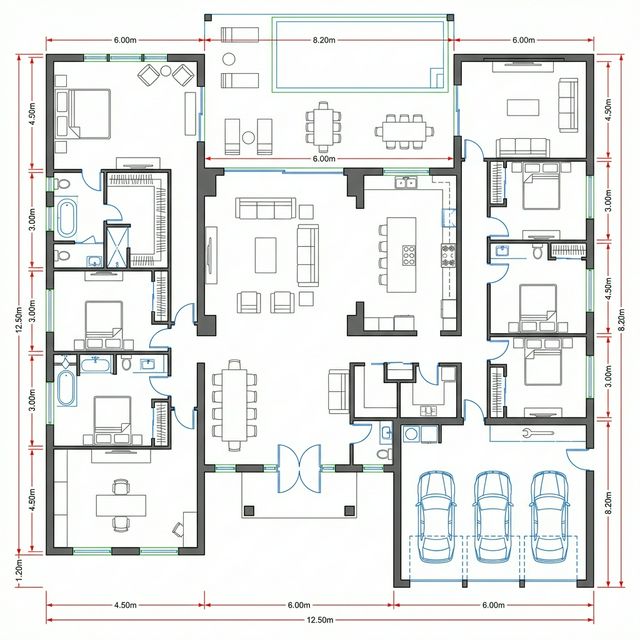
Regulations constrain design, and treating them as a checklist at the end produces worse buildings than designing with them from the start.
Regulatory requirements are frequently treated as a hurdle cleared after the design is resolved. Designs developed that way either get rejected or get modified in ways that damage them. Working with the constraints from the beginning produces better buildings and faster approvals.
Before stage one
Before design begins, the applicable requirements for the specific plot should be established in writing rather than assumed from general knowledge.
- Land use and permitted building ratio for the plot.
- Setbacks, height limits and any constraints specific to the location.
- Parking requirements for the intended use.
- Any requirements applying to the specific building type.
Stage 1: Establish the envelope
Define the three dimensional envelope within which the building must sit, before any design work.
- Deliverable: A diagram of the permitted envelope.
- Owner: Engineering office.
- Approval gate: Design begins within the confirmed envelope.
Stage 2: Test the programme against the envelope
Check whether the required areas fit within the envelope, and resolve any conflict before designing in detail.
- Deliverable: A feasibility check of programme against envelope.
- Owner: Architect.
- Approval gate: Conflict resolved by adjusting the brief or the expectations, not by hoping for flexibility.
Stage 3: Design with the constraints
Develop the design so that compliance is inherent rather than checked afterwards, including parking, access and any required provisions.
- Deliverable: A design that satisfies requirements by its arrangement.
- Owner: Architect.
- Approval gate: No element relies on an exception being granted.
Stage 4: Internal compliance review
Check the design systematically against each requirement before submission.
- Deliverable: A compliance checklist completed.
- Owner: Engineering office.
- Approval gate: Every requirement addressed before submission.
Stage 5: Submit and respond
Submit and address any comments precisely, amending rather than arguing where the requirement is clear.
- Deliverable: Approved drawings.
- Owner: Engineering office.
- Approval gate: All comments addressed in one resubmission.
Stage 6: Build to the approved design
Ensure construction follows the approved drawings, and process any material change properly.
- Deliverable: A built condition matching the approval.
- Owner: Contractor under supervision.
- Approval gate: Deviations approved before they are built.
Handovers between stages
The costly handover is between approval and construction. Changes made on site that depart from the approved drawings create a discrepancy that surfaces at completion, at sale or during financing, sometimes years later.
How you know it is finished
Compliance is achieved when the approved design satisfies requirements through its arrangement, the built condition matches the approval, and the documentation is retained with the property records.
If you are starting a design, Domira can help you write the brief, review the drawings and keep the design aligned with the budget before it reaches a contractor.
Frequently Asked Questions
Do regulations limit good design?
They constrain it, and constraints are not the same as limitations. Requirements such as setbacks and height limits shape the building, and working with them deliberately generally produces a more coherent result than treating them as obstacles.
What if my design does not fit within the permitted envelope?
Adjust the design or the expectations, since building outside the permitted envelope creates problems at approval and at every subsequent transaction. Where flexibility exists, it is obtained through proper process rather than assumed.
Can I modify the building after approval?
Material changes should be processed through the proper route before being built. Regularising afterwards is slower, more expensive and sometimes impossible, and an unapproved change can block completion documentation when you need it most.
Have a Property Question?
Domira can help you navigate property, financing and investment decisions in Saudi Arabia. Speak with our team for an initial consultation.