
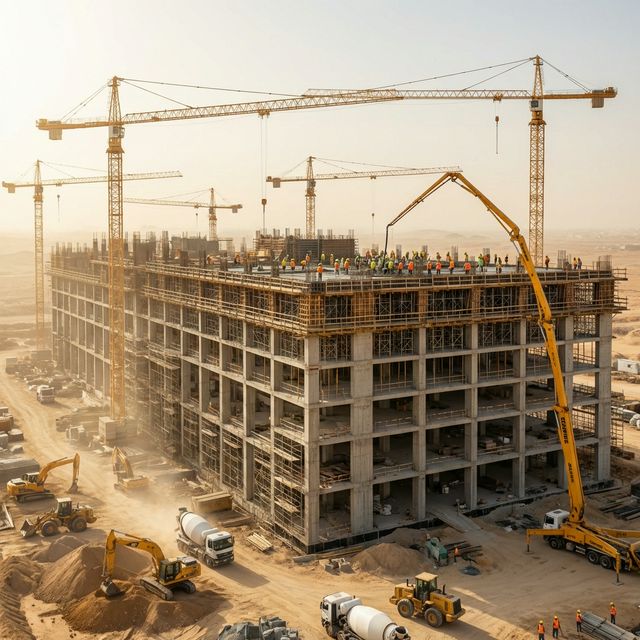
Demolition looks like the simplest part of a project and carries some of its highest risks. The sequence that keeps it controlled.
Demolition is treated as clearing the way for the real work, which is why it is often the least planned stage of a project and the one most likely to affect neighbours, utilities and the programme.
Before stage one
Before anything is demolished, three things must be confirmed: that services have been disconnected properly, that the structure will come down in a controlled sequence, and that adjacent properties have been surveyed and documented.
- Utility disconnections confirmed in writing by the relevant providers.
- Structural assessment of what is being removed and what remains.
- Condition survey of adjacent properties with dated photographs.
- Permissions in place where required for the works.
Stage 1: Survey and documentation
Record the existing building and the condition of neighbouring properties, including any pre-existing cracks or damage.
- Deliverable: Photographic condition survey with dates.
- Owner: Owner or appointed consultant.
- Approval gate: Survey completed before any machinery arrives on site.
Stage 2: Service disconnection
Disconnect electricity, water, drainage and telecommunications formally rather than by cutting on site.
- Deliverable: Written confirmation of disconnection from each provider.
- Owner: Owner through the contractor.
- Approval gate: No demolition begins until every disconnection is confirmed.
Stage 3: Hazardous material check
Identify any materials in older buildings requiring specialist removal and handle them through the appropriate route.
- Deliverable: An assessment and, where required, a specialist removal plan.
- Owner: Specialist assessor.
- Approval gate: Clearance obtained before general demolition proceeds.
Stage 4: Protection and separation
Erect hoarding, protect adjacent structures and plan dust and noise control, particularly in dense residential areas.
- Deliverable: Protection in place and agreed working hours.
- Owner: Contractor.
- Approval gate: Protection verified before demolition starts.
Stage 5: Controlled demolition
Demolish in the planned sequence, retaining any elements to be kept and maintaining stability throughout.
- Deliverable: Structure removed to the agreed level with retained elements intact.
- Owner: Demolition contractor.
- Approval gate: Daily review of stability where partial demolition is involved.
Stage 6: Clearance and disposal
Remove debris, separate recyclable material where practical, and leave the site at the level required for construction.
- Deliverable: Cleared site with disposal documentation.
- Owner: Contractor.
- Approval gate: Site levels verified against the construction requirements.
Stage 7: Post-demolition survey
Re-survey adjacent properties and the site itself to record the condition after works.
- Deliverable: Comparative survey closing out the pre-demolition record.
- Owner: Owner or consultant.
- Approval gate: Any damage identified and addressed before construction begins.
Handovers between stages
The weakest handover is between service disconnection and demolition, where assumptions are dangerous. Written confirmation from each provider, rather than an assurance that a line looks dead, is the only acceptable evidence before machinery starts.
How you know it is finished
The stage is complete when the site is cleared to the required level, disposal is documented, adjacent properties have been re-surveyed, and any damage has been resolved before construction begins rather than argued about at the end.
If you are preparing to build, Domira can review your drawings, scope and contractor offers before you commit, and supervise delivery against the programme and specification you agreed.
Frequently Asked Questions
Do I need approval to demolish a building?
Requirements vary by location and by what is being demolished, and they often connect to the permit for the new construction. Confirm the requirement with a licensed engineering office before starting, since retrospective compliance is considerably harder than doing it in order.
How do I protect myself against neighbour claims?
A dated photographic condition survey of adjacent properties before demolition begins is the single most effective protection. It converts a subjective dispute into a factual comparison, in whichever direction the facts point.
Can demolition material be reused?
Some material has value, particularly steel, and crushed concrete can sometimes be used as fill depending on quality and requirements. Where reuse is intended, it should be planned before demolition so material is separated rather than mixed, since separation afterwards rarely justifies the cost.
Have a Property Question?
Domira can help you navigate property, financing and investment decisions in Saudi Arabia. Speak with our team for an initial consultation.
