
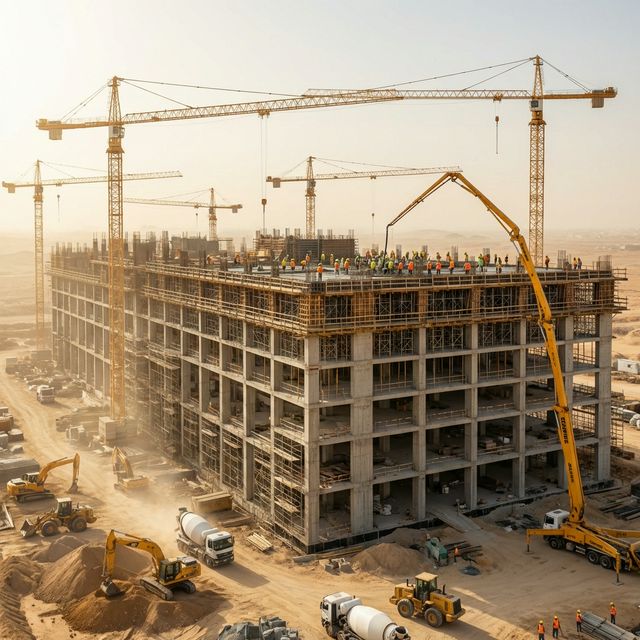
Material waste, rework and idle time rarely appear as line items, yet they consume a real share of every construction budget.
No budget contains a line called waste, which is precisely why it is rarely managed. It is distributed across material orders, labour hours and programme duration, and it is paid for whether or not anyone measures it.
What this number does and does not include
This covers avoidable losses during construction: material over-ordering and damage, rework of non-compliant work, and time lost to waiting. It excludes the unavoidable offcuts inherent in cutting materials to size.
Over-ordering and unused material
Material bought beyond requirement, either as a precaution or because quantities were estimated rather than measured.
- Pushes it up: Rough quantity estimates, unclear drawings and ordering to avoid a second delivery.
- Brings it down: Measured quantities from drawings, with a defined allowance rather than a generous guess.
- How to control it: Compare ordered quantities against measured requirements at each stage rather than at the end, when the difference is already spent.
Damage and poor storage
Material damaged on site by weather, handling or being stored where other trades work.
- Pushes it up: Unprotected storage, early delivery of finishing materials and congested sites.
- Brings it down: Deliveries scheduled close to installation and designated protected storage.
- How to control it: Make storage arrangements a contractual requirement and inspect them, particularly before finishing materials arrive.
Rework of non-compliant work
Work that must be removed and redone because it does not meet the specification or conflicts with another trade.
- Pushes it up: Weak supervision, uncoordinated drawings and instructions given verbally.
- Brings it down: Inspection at hold points and coordinated drawings before work begins.
- How to control it: Track rework as its own figure. Once it is visible, it usually falls, because nobody defends a number that measures avoidable loss.
Waiting and idle time
Crews on site unable to proceed because of missing materials, pending decisions or another trade not finishing.
- Pushes it up: Late owner decisions, poor sequencing and materials ordered without regard to lead time.
- Brings it down: A decision schedule agreed at the start, and procurement planned against the programme.
- How to control it: Keep a decision log with dates. Owner delay is the most common cause of idle time and the easiest to fix.
Disposal and clearance
Removing debris, packaging and surplus material from site, repeatedly, throughout the project.
- Pushes it up: High waste volumes, congested sites requiring multiple clearances and demolition work.
- Brings it down: Ordering closer to requirement, and planning cutting to reduce offcuts on sheet and tile materials.
- How to control it: Require site clearance as a standing obligation rather than an end-of-project activity, since a clear site also reduces damage and accidents.
Costs that never appear on the first page
- The labour already paid for in work that must be redone.
- Programme time consumed by rework, which extends preliminaries.
- Replacement material for damaged stock, often bought at retail rather than contract rates.
- Management time spent resolving avoidable disputes about who caused a loss.
Keeping the budget honest
Waste is managed by measurement, not exhortation. Measure ordered against installed quantities for the main materials, track rework separately, and log idle days with their cause. Three simple measurements remove most avoidable loss because they make it visible to both parties.
- At the end of the structural stage, comparing steel and concrete ordered against measured requirements.
- Before finishing materials are delivered, to confirm storage is ready.
- Monthly, reviewing rework and idle days with the contractor.
- At handover, comparing final ordered quantities against the original bill of quantities.
If you are preparing to build, Domira can review your drawings, scope and contractor offers before you commit, and supervise delivery against the programme and specification you agreed.
Frequently Asked Questions
Who pays for material waste, the owner or the contractor?
It depends on the contract. Under a lump sum, the contractor absorbs waste inside the priced scope, which is why an allowance is built into the price. Under cost plus, the owner pays for it directly, which is why measurement matters far more in that arrangement.
Is a certain amount of waste unavoidable?
Yes. Cutting tiles, blocks and boards to size produces offcuts, and a reasonable allowance is legitimate. What is avoidable is over-ordering, damage from poor storage and rework, which typically exceed the unavoidable component.
How do I raise waste with a contractor without souring the relationship?
Present it as measurement rather than accusation: compare ordered and installed quantities and ask about the difference. Most contractors respond well to a factual question and poorly to an implication, and the measurement itself usually changes behaviour without any confrontation.
Have a Property Question?
Domira can help you navigate property, financing and investment decisions in Saudi Arabia. Speak with our team for an initial consultation.
