
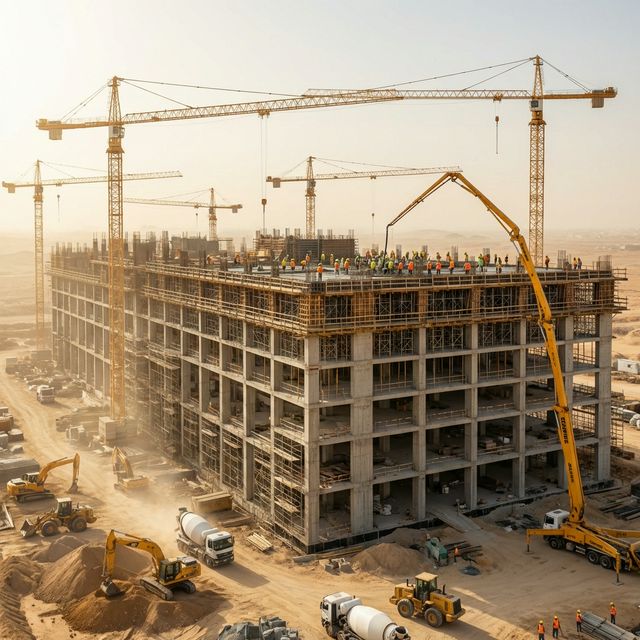
Safety on site is the contractor's duty to manage, but the consequences of failure reach the owner. The gaps that matter most.
Most private owners assume safety is entirely the contractor's domain, which is largely true in terms of day-to-day management. What owners underestimate is how much of the risk, disruption and reputational consequence still lands on them when something goes wrong on their plot.
Why these keep happening
The recurring theme is procurement: safety is priced out during tendering, then expected on site for free. A contractor who was never paid for scaffolding, edge protection and supervision will not provide them out of principle.
1. Selecting a contractor without asking about safety at all
Tender evaluation focuses on price and programme, and safety questions feel like paperwork.
- Avoid it by: Ask for the safety arrangement in the tender: who supervises, what equipment is provided, and what the record of the proposed team is.
- Proof it is closed: A written safety method statement forming part of the contract documents.
What it costs you: You discover the contractor's approach to safety after an incident, when your site is stopped and your project is delayed.
2. Treating safety items as an easy saving during negotiation
Scaffolding, edge protection and access equipment appear in preliminaries, which is the first place owners look for savings.
- Avoid it by: Treat access and protection as fixed items rather than negotiable ones, and keep them itemised.
- Proof it is closed: Preliminaries priced transparently, with access and protection listed rather than bundled.
What it costs you: The work continues without them, productivity suffers, quality suffers at height, and the exposure is real.
3. No control over who enters the site
Family members, suppliers and curious neighbours visit routinely, particularly on residential plots in occupied neighbourhoods.
- Avoid it by: Require perimeter hoarding, a lockable gate and a rule that all visitors are accompanied.
- Proof it is closed: Secure perimeter in place from the first day of work, not after the structure rises.
What it costs you: Untrained visitors walking through an active site is one of the most common causes of injury, and children are the greatest concern.
4. Ignoring the neighbours entirely
Notification feels like an invitation to complaints.
- Avoid it by: Notify neighbours before starting, record the condition of adjacent properties with dated photographs, and agree delivery times.
- Proof it is closed: Dated condition survey of adjacent properties, taken before mobilisation.
What it costs you: Dust, noise, blocked access and damage to adjacent property generate disputes that can stop work far more effectively than any inspection.
5. Assuming insurance is in place
It is mentioned once during negotiation and rarely verified afterwards.
- Avoid it by: Require copies of current policies before mobilisation and confirm they remain valid for the contract period.
- Proof it is closed: Policy documents on file with expiry dates diarised.
What it costs you: After an incident, an uninsured or lapsed policy leaves the exposure with whoever can be reached, which frequently means the owner.
A short check before you sign
- Does the contract include a safety method statement?
- Are access and protection items priced rather than assumed?
- Is the perimeter secure and access controlled?
- Have adjacent properties been surveyed and photographed before work started?
- Are current insurance policies on file and valid for the contract period?
If it has already happened
If work is already underway without these arrangements, address the perimeter and insurance first, since both can be corrected within days and both carry the largest consequences. Then record the current condition of adjacent properties, even late, because a survey taken during the works is still better evidence than none when a neighbour raises a claim at the end.
If you are preparing to build, Domira can review your drawings, scope and contractor offers before you commit, and supervise delivery against the programme and specification you agreed.
Frequently Asked Questions
Is the owner liable for accidents on site?
Primary responsibility for site safety rests with the contractor managing the works, but exposure depends on the contract, the circumstances and the insurance in place. This is precisely why verifying insurance and requiring a written safety arrangement matter more than the general principle.
Should I insure the works myself?
The contract should state who insures the works and to what value. Owners often carry or require contractor's all risks cover, along with third party liability. What causes problems is ambiguity, where each party assumes the other arranged it.
How do I handle a neighbour claiming damage from my construction?
Compare the claim against your pre-construction condition survey. With dated photographs taken before mobilisation, most claims resolve quickly in one direction or the other. Without them, the discussion becomes a negotiation rather than a factual question.
Have a Property Question?
Domira can help you navigate property, financing and investment decisions in Saudi Arabia. Speak with our team for an initial consultation.
