
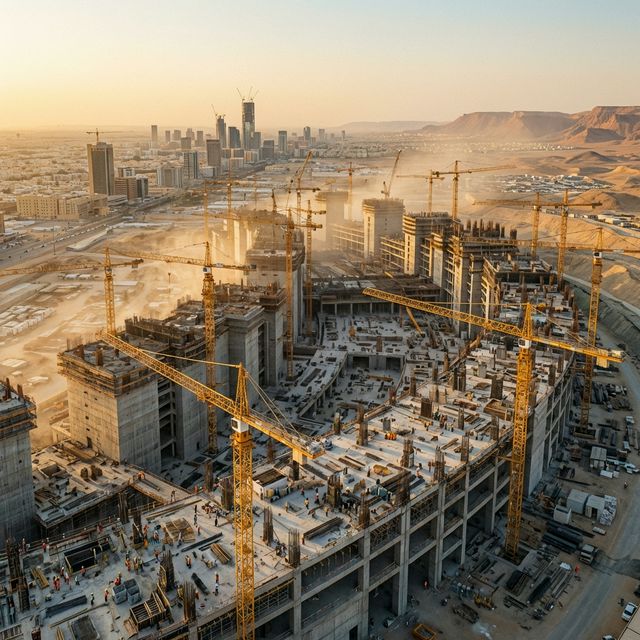
Six widely repeated ideas about building in Saudi Arabia, examined against what actually happens on site.
Construction advice circulates in family groups and majlis conversations with great confidence and very little evidence. Some of it is sound. The six beliefs below are repeated often enough to influence real decisions, and each deserves a closer look.
How to test a claim like this
A useful test for any construction claim is simple: ask what document would prove it. Claims that survive contact with a bill of quantities, a test result or a signed programme are worth acting on. Claims that exist only in conversation are not.
Myth 1: The lowest price will end up costing the most
Reality: Not always. A low price can reflect genuine advantage, such as crews already working nearby, materials bought in bulk, or a quieter period in the contractor's programme. The danger is not a low number, it is an unexplained one.
How to check it yourself: Ask the lowest bidder to explain three specific line items and compare their assumed quantities with the other bids. Real advantages are easy to describe; omissions are not.
Myth 2: A bigger contractor always means better quality
Reality: Size indicates capacity, not care. A large firm may assign an inexperienced team to a small villa while a smaller specialist gives it senior attention.
How to check it yourself: Ask who specifically will run your project, how many other sites they run simultaneously, and visit one of those sites.
Myth 3: Structural work is where you should never economise, and finishes are where you can
Reality: Half right. Structure and waterproofing should not be economised. Finishes can be, but only by lowering specification, not workmanship, since poor workmanship on finishes is what makes a house feel cheap regardless of material cost.
How to check it yourself: Separate material grade from installation quality in the specification, and approve samples of both.
Myth 4: A fixed price contract means the price cannot change
Reality: It means the price for the defined scope cannot change. Anything outside that scope, and anything you decide to alter, is a variation priced without competition.
How to check it yourself: Count the provisional sums in the tender. The more there are, the less fixed the fixed price actually is.
Myth 5: Supervision is an extra cost you can skip if you visit the site yourself
Reality: Site visits confirm that work is happening. They do not verify reinforcement before a pour, concrete test results, or whether a claimed sixty per cent completion is truly sixty per cent.
How to check it yourself: Ask yourself who will certify the next payment. If the answer is the contractor's own progress report, supervision is not optional.
Myth 6: Defects appear immediately or not at all
Reality: The most expensive defects, particularly in waterproofing and drainage, appear in the first heavy rain or the first summer after handover, well after most owners have released final payment.
How to check it yourself: Retain a percentage until the defects liability period ends, and schedule a formal inspection before releasing it rather than letting the date pass quietly.
What this changes in your decision
- Judge a bid by the completeness of its assumptions, not by its position in the list.
- Ask which named individuals will run the project, and verify them.
- Protect structure, waterproofing and insulation from value engineering.
- Count provisional sums before believing a price is fixed.
- Keep retention and use the defects period deliberately.
If you are preparing to build, Domira can review your drawings, scope and contractor offers before you commit, and supervise delivery against the programme and specification you agreed.
Frequently Asked Questions
Is it reasonable to ask a contractor for their subcontractors?
Yes. Much of the work on a residential project is executed by specialist subcontractors, so the quality of the electrical, plumbing and finishing trades matters as much as the main contractor. Asking who they intend to use, and whether those teams have worked together before, is a fair and revealing question.
Should I pay an advance payment before work starts?
A mobilisation advance is normal so the contractor can order material and set up the site. What protects you is proportion and security: keep it modest, tie it to mobilisation actually happening, and recover it progressively from subsequent payments rather than treating it as a gift at the start.
How do I verify concrete quality without technical knowledge?
You do not need to judge it yourself. Require cube test results from an accredited laboratory for each pour and make them a condition of the related payment. Your supervising engineer reads the results; your contract makes sure they exist.
Have a Property Question?
Domira can help you navigate property, financing and investment decisions in Saudi Arabia. Speak with our team for an initial consultation.
