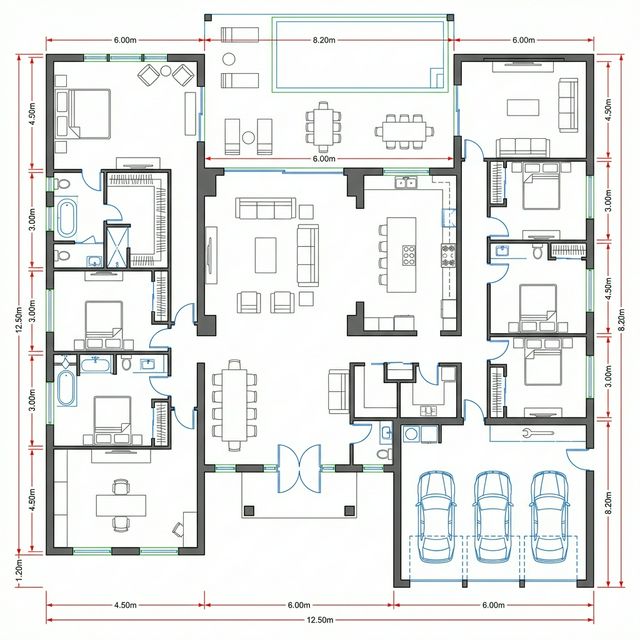
Style is not only appearance. The choice affects cost, maintenance and how the building performs in this climate.
The choice between a contemporary and a traditionally influenced design is usually framed as taste. It also determines detailing complexity, maintenance demands and how the building responds to climate, which makes it a practical decision as well as an aesthetic one.
Contemporary at a glance
Clean geometry, large openings where appropriate, restrained material palette and an emphasis on volume and light.
Traditionally influenced at a glance
Design drawing on regional precedents: courtyards, screened openings, thicker walls, and shading integrated into the building form.
Climate performance
Contemporary: Depends entirely on the shading strategy, since the form itself provides little protection.
Traditionally influenced: Often better by default, because the devices evolved as climate responses before they became stylistic.
Detailing complexity
Contemporary: Simpler in principle, though clean detailing demands high accuracy and exposes poor workmanship.
Traditionally influenced: More complex, with screens, reveals and articulated elements requiring craft.
Construction cost
Contemporary: Generally lower where the geometry is straightforward.
Traditionally influenced: Higher where bespoke elements and detailed work are involved.
Maintenance
Contemporary: Simpler surfaces, though large glazed areas require regular attention.
Traditionally influenced: More elements to maintain, particularly screens and articulated facades.
Resale appeal
Contemporary: Broad, though a strongly minimal design can narrow the market.
Traditionally influenced: Distinctive, which attracts some buyers strongly and others not at all.
When contemporary wins
- You want simpler detailing and construction.
- The plot and orientation allow openings to be placed generously with shading.
- Maintenance simplicity matters.
- The intended market or future buyer favours contemporary design.
When traditionally influenced wins
- Climate performance through inherited devices is a priority.
- Privacy requirements align with screened openings and courtyards.
- You want the building to belong to its place visually.
- The craft skills for the detailing are available locally.
How to decide
Choose based on how you want the house to perform and be maintained, not only on how it should look. Where climate performance and privacy are priorities, traditional devices deserve serious consideration. Where simplicity and cost matter most, contemporary design with a rigorous shading strategy is the more direct route.
Whichever direction you choose, ask to see a completed building by the same architect in that idiom, and visit it. Renderings flatter both directions equally; a finished building reveals how the detailing was resolved and how it has aged.
If you are starting a design, Domira can help you write the brief, review the drawings and keep the design aligned with the budget before it reaches a contractor.
Frequently Asked Questions
Can the two be combined?
Frequently and successfully: contemporary geometry with traditional climate devices such as screens, courtyards and deep reveals. What tends to fail is applying traditional decoration to a contemporary building, which produces neither performance nor coherence.
Does traditional design cost more?
Usually, because of detailing complexity and craft content. Whether it is worth the premium depends on whether the devices are performing as well as decorating, since a courtyard and screened openings earn their cost in comfort while applied ornament does not.
Which holds value better?
Quality of execution matters more than style. A well-built, well-detailed house in either idiom holds value better than a poorly executed example of the currently fashionable one, and fashion changes within the life of a building.
Have a Property Question?
Domira can help you navigate property, financing and investment decisions in Saudi Arabia. Speak with our team for an initial consultation.