
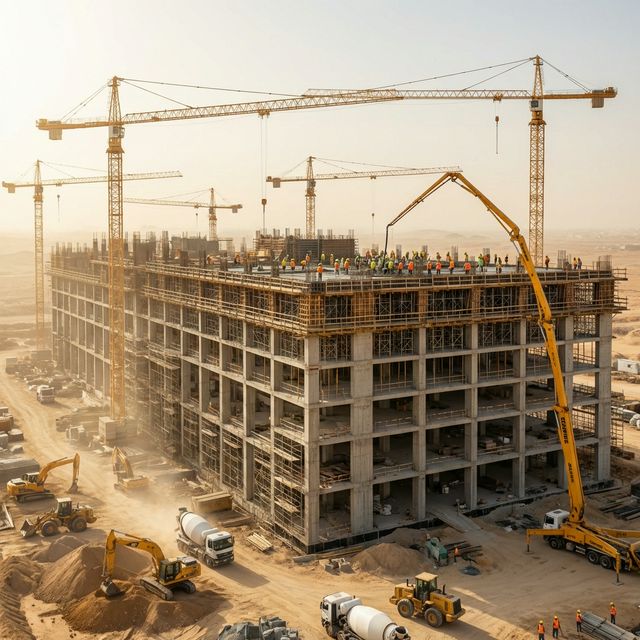
A project two hours from the nearest concrete plant is a different commercial proposition. The supply cost lines that only appear on remote sites.
Distance changes construction economics in ways that a cost per square metre comparison never captures. Concrete has a limited travel time, deliveries arrive in fewer and larger loads, storage becomes necessary, and any shortage costs a day rather than an hour. If your plot is outside the main urban supply networks, these are the lines to plan for.
What this number does and does not include
This covers the additional supply and logistics cost of building on a site distant from established material sources in Saudi Arabia. It excludes the construction work itself, land cost, and the separate question of utility connections to a remote plot.
Concrete supply and travel time
Ready mixed concrete has a limited usable period from batching, so distance governs whether it can be supplied at all.
- Pushes it up: Long haul distances, single access routes, and pours large enough to require continuous supply over many hours.
- Brings it down: A site batching plant for high volume projects, or scheduling pours in sizes the supply chain can sustain.
- How to control it: Establish the nearest plants and their travel times before design decisions fix pour sizes, and price a site plant against haulage for large volumes.
Freight and delivery premiums
Transport cost per unit rises with distance, and suppliers price remote delivery with a margin for the risk of a wasted trip.
- Pushes it up: Frequent small deliveries, urgent orders, and routes that require special permits or escorts.
- Brings it down: Consolidated deliveries planned from the procurement schedule rather than from daily needs.
- How to control it: Plan deliveries from the programme in consolidated loads, and make the delivery schedule a contractual obligation rather than an intention.
On site storage and protection
Remote sites must hold more material, which requires secure, shaded and weatherproof storage.
- Pushes it up: Materials sensitive to heat or moisture, high value items, and a site with no secure compound.
- Brings it down: Just in time delivery for anything that can be reliably supplied, and covered storage sized to real need.
- How to control it: Require a storage plan in the mobilisation submittals and inspect it, since damaged stored material is a cost nobody budgets.
Labour accommodation and transport
Workers on a remote site must be housed and moved, which turns a daily commute into a capital and operating cost.
- Pushes it up: Distance from any town, large workforce peaks, and requirements for compliant accommodation standards.
- Brings it down: A smaller and more continuous workforce rather than large peaks, and accommodation shared across phases.
- How to control it: Confirm the applicable accommodation and transport requirements with the relevant authority, and ask how the contractor priced them rather than assuming they did.
Plant mobilisation and standby
Equipment costs more to bring to a remote site and cannot be released and recalled economically, so it stands idle between uses.
- Pushes it up: Specialist plant needed briefly, breakdowns requiring parts from a city, and long mobilisation distances.
- Brings it down: Sequencing work so each machine has continuous use, and choosing methods that use common equipment.
- How to control it: Review the plant schedule against the programme and challenge items standing for weeks between short uses.
Supervision and testing attendance
Engineers, inspectors and laboratories must travel, so each visit costs more and cannot be arranged at short notice.
- Pushes it up: Frequent hold points scattered across the week, and testing that must be witnessed.
- Brings it down: Clustering hold points so one visit covers several, without lowering the standard applied.
- How to control it: Design the inspection and test plan around travel realities at the start, rather than discovering that inspections are being skipped for cost.
Contingency for supply failure
On a remote site a missing item stops work, because there is no local merchant to bridge the gap.
- Pushes it up: Single source materials, imported items, and a programme with no float on procurement.
- Brings it down: Approved alternative sources identified in advance and modest buffer stock of critical consumables.
- How to control it: Identify single points of failure in the procurement schedule and require a named second source for each one.
Costs that never appear on the first page
- Waste rising because material delivered in bulk deteriorates or is damaged before use.
- Small variations becoming expensive because a minor extra item requires its own delivery.
- Subcontractors pricing remote work at a premium that arrives as a variation rather than in the tender.
- Staff turnover on remote sites, with the knowledge loss that accompanies it.
- Emergency transport of a single item by dedicated vehicle, which happens more often than anyone plans for.
Keeping the budget honest
Price logistics as a package before you price the building. Establish travel times to concrete plants and major suppliers, decide how the workforce will be housed and moved, and identify the items with only one source. Those three questions determine whether a remote plot is cheaper than a serviced one, and the answer is sometimes that it is not.
- Before acquiring or committing to the plot, when logistics can still change the decision.
- At design stage, when pour sizes, structural system and material choices are still open.
- At tender, comparing how each bidder priced logistics rather than only the total.
- At the start of each construction phase, since the logistics profile changes between structure and finishes.
Domira designs, builds and manages projects across Saudi Arabia for owners who are based abroad: land appraisal, feasibility, design, construction, handover and asset management under one accountable contract. Send us the plot or the brief and Domira will put the numbers in front of you before you commit.
Frequently Asked Questions
How does distance from a city affect construction cost in Saudi Arabia?
It affects concrete supply, delivery premiums, storage, labour accommodation and transport, plant mobilisation and the cost of supervision attendance. The effect is not a simple percentage, because some items scale with distance and others jump once a threshold is passed, such as when concrete can no longer arrive within its usable period. Establish those thresholds for your specific plot before design decisions are fixed.
When does a site batching plant make sense instead of delivered concrete?
When the volume is large enough to absorb the setup cost, when travel time from the nearest plant threatens the quality or continuity of pours, or when the programme requires pours that no supplier can sustain by road. It brings its own obligations: material storage, quality control, testing and competent operation. Compare it against haulage on volume, quality risk and programme rather than on price per cubic metre alone.
How much buffer stock should a remote construction site hold?
Enough of the items that stop work to cover the realistic replenishment time, and no more, because stored material deteriorates and ties up cash. The analysis is item by item: consumables and fixings are cheap to hold and expensive to run out of, while finishing materials are expensive to hold and easy to damage. Ask the contractor to propose the buffer list and challenge anything that looks like storing your money.
Have a Property Question?
Domira can help you navigate property, financing and investment decisions in Saudi Arabia. Speak with our team for an initial consultation.

