
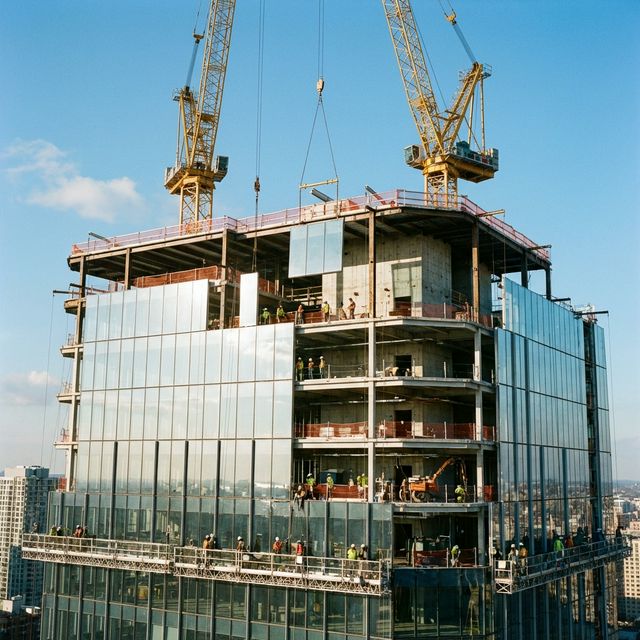
The recurring errors in gated compound projects in Saudi Arabia, what each one costs in rent or capital, and the evidence that proves it has been closed out.
Compound projects go wrong in a predictable order: amenities are promised before they are costed, infrastructure is discovered late, and no operator is appointed until the tenants arrive. Each error is cheap to avoid at brief stage and expensive once concrete is poured. These are the ones we see repeatedly on schemes owned from abroad, with the proof that each has been dealt with.
Why these keep happening
The common root is that a compound is treated as a construction project when it is really an operating business with a construction phase. Construction thinking optimises for handover, and an operating business needs to be optimised for year five. Whenever a decision is taken on what is cheapest to build rather than what is cheapest to run and easiest to let, the same failures appear.
1. Promising amenities before costing their operation
Pools, gyms, landscaped gardens and a staffed gatehouse are easy to add to a marketing plan and hard to remove once tenants have signed on the strength of them. Each carries chemicals, power, water, servicing and staff for the life of the asset, and irrigated planting in a hot climate consumes water every day of the year.
- Avoid it by: Cost every amenity annually before the masterplan is drawn, and delete any item whose cost exceeds the premium it supports.
- Proof it is closed: A signed amenity schedule showing annual running cost per item against the rent premium it justifies.
What it costs you: An annual operating cost that consumes the rent premium the amenities were supposed to create, permanently.
2. Leaving infrastructure capacity to be confirmed later
Power capacity, water supply, drainage and telecoms for a multi-unit scheme are a different proposition from a single villa connection. Owners assume that because the plot sits in a serviced area, the capacity for twenty units is available at the boundary. Sometimes it is not, and the remedy involves an upgrade outside your plot and outside your control.
- Avoid it by: Obtain written capacity and connection confirmation from each utility provider before finalising the masterplan.
- Proof it is closed: Written confirmations on file, with capacity figures matched to the scheme load calculations.
What it costs you: Programme delay measured in months, redesign of the services strategy, and in some cases an unbudgeted infrastructure contribution.
3. Building unit types that cannot be repeated
Individually designed units feel like a premium offer and behave like a series of one-off projects. Each variation means new drawings, new quantities, new subcontractor learning and new defects, and it removes the one real advantage a compound has over scattered villas.
- Avoid it by: Limit the scheme to two or three unit types, prototype each once, then run them as a repeat production line.
- Proof it is closed: A unit type register showing only the approved types, with the prototype sign-off for each.
What it costs you: Higher build cost per unit and a longer programme, with defects reappearing in every variation.
4. Letting tenants move in next to live construction
The pressure to start collecting rent from phase one is real, and it pushes owners to occupy before the boundary between finished and unfinished is properly formed. Dust, noise, blocked access and construction traffic then define the tenant experience of a product sold as calm and private.
- Avoid it by: Define a hard phase boundary with separate construction access and complete the amenities serving the occupied phase.
- Proof it is closed: A phase completion certificate covering the boundary, access route and amenities before any lease starts.
What it costs you: Early renewals lost, rent discounts given to keep tenants, and a reputation problem that follows the compound.
5. Appointing the operator after handover
A compound handed to an operator who never saw it built has no asset register, no warranty trail and no knowledge of where the isolation valves are. The first year is then spent rediscovering the building instead of maintaining it, and warranties expire before anyone knows they existed.
- Avoid it by: Appoint the operator before practical completion and require attendance at commissioning of the main plant.
- Proof it is closed: Operator acceptance of the asset register and warranty schedule, signed before retention release.
What it costs you: Avoidable repair spend in year one and lost warranty claims on plant that failed inside its cover.
6. Ignoring privacy and overlooking in the masterplan
Units placed for plot efficiency often look straight into each other or onto the road. In a market where household privacy is a primary requirement, an overlooked terrace or a window facing a neighbour is not an aesthetic issue, it is the reason a family chooses a different compound.
- Avoid it by: Test sightlines between units and from public areas at masterplan stage, and use walls, levels and window placement to resolve them.
- Proof it is closed: A sightline study for every unit position, reviewed and signed at masterplan approval.
What it costs you: Slower letting and lower achieved rent on the affected units, for the life of the asset.
A short check before you sign
- Every amenity has a written annual operating cost and a rent premium attached to it.
- Written utility capacity confirmations are on file and match the scheme load calculations.
- The unit type register lists only prototyped types, with sign-off for each.
- Phase boundaries, construction access and amenity completion are defined before any lease is signed.
- The operator is appointed, has the asset register and attended plant commissioning.
- A sightline and privacy study exists for every unit position.
If it has already happened
If the compound is already built and underperforming, start with the operating cost line rather than the rent. Recost every amenity, close or reduce anything that consumes more than it returns, and renegotiate service contracts using the asset register you may have to build retrospectively. Where privacy is the problem, targeted screening, planting and window treatment can recover part of the rent gap for far less than a redesign. Only after operating cost and lettability are fixed should you revisit the rent, because a poorly run compound cannot support a premium no matter how the price is presented.
Domira designs, builds and manages projects across Saudi Arabia for owners who are based abroad: land appraisal, feasibility, design, construction, handover and asset management under one accountable contract. Send us the plot or the brief and Domira will put the numbers in front of you before you commit.
Frequently Asked Questions
Why do compound developments in Saudi Arabia underperform their feasibility studies?
Usually because the operating cost of the amenities and services was estimated optimistically while the rent premium was estimated generously. The premium is charged once a year and the running cost accrues daily. Recost every service line annually at design stage, then check the premium against real lettings evidence from agents in the same district rather than asking price data.
How many villa types should a compound have?
Two or three is usually the practical limit. Repetition is the main cost and quality advantage a compound has, because subcontractors learn the unit and defects get designed out after the prototype. More variety means more drawings, more quantities and more first-time mistakes, and tenants rarely pay a premium for variation they cannot see from inside their own house.
Can I start letting a compound before all phases are finished?
Yes, but only if the occupied phase is genuinely separated: its own access, a solid hoarding line, completed landscaping and working amenities. Tenants who live through construction ask for discounts and leave at the first renewal. The rent gained early is often less than the rent lost through concessions and vacancy afterwards.
Have a Property Question?
Domira can help you navigate property, financing and investment decisions in Saudi Arabia. Speak with our team for an initial consultation.

