
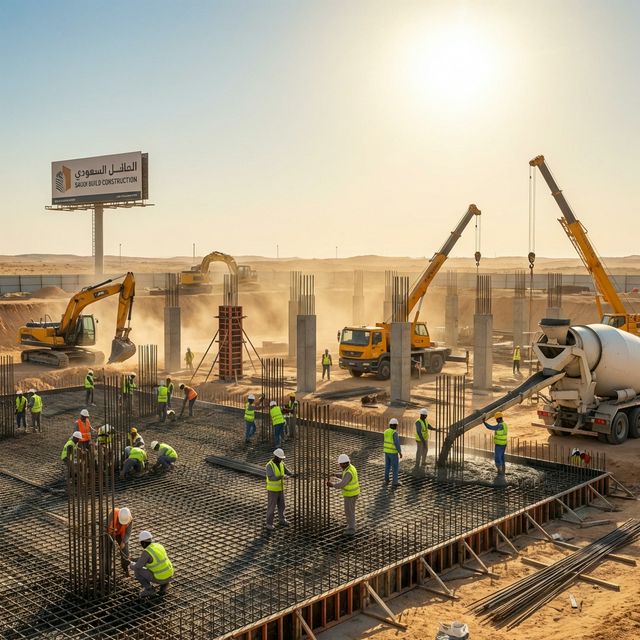
Preliminaries are what it costs to run a site rather than to build the building. What sits inside them, what drives them and why they scale with time.
Preliminaries are the cost of running a construction site: management, offices, cranes, scaffolding, temporary power, safety, security and cleaning. They build nothing and they are a significant part of every contract sum. They also scale with time rather than with quantity, which is why a delay costs so much more than the value of the work being delayed.
What this number does and does not include
This covers the site-level overheads a contractor prices in the preliminaries section of a tender, sometimes called general requirements. It excludes the measured work of the building itself, the contractor head office overhead and profit, and the owner side fees. Amounts are driven by project duration, site conditions and the contractor own organisation, so what follows are the drivers rather than any rate.
Site management and supervision
The project manager, site engineers, foremen, quantity surveyor, safety officer and administrative staff who run the works. It is usually the largest preliminaries item and the most directly proportional to programme length, because these people are paid monthly regardless of how much work is produced.
- Pushes it up: A long programme, a complex build requiring more supervision and a project with many concurrent trades.
- Brings it down: A short programme, a simple repetitive building and a contractor with an efficient team structure.
- How to control it: Price it as a monthly rate in the tender so the cost of any extension is known in advance rather than argued about later.
Site establishment and accommodation
Offices, stores, welfare facilities, hoarding, fencing, signage, access roads and the setting up and removal of all of it. Largely a fixed cost at the start and end, with a smaller running element in between.
- Pushes it up: A constrained site with no space, a requirement for off-site facilities and long-distance access arrangements.
- Brings it down: A spacious site with existing access and room for stores within the boundary.
- How to control it: Provide clear site information at tender so every bidder prices the same constraints instead of guessing.
Craneage, hoists and major plant
Tower crane or mobile cranes, hoists, pumps and other plant required for the project as a whole rather than for one trade. Hire is charged by time, so this line moves directly with programme and with how efficiently the plant is used.
- Pushes it up: A tall building, a tight plot requiring a tower crane, a long programme and plant standing idle between phases.
- Brings it down: A low-rise building, good access allowing mobile plant and a well sequenced programme.
- How to control it: Ask for the plant schedule with durations, and check it against the programme rather than accepting a lump figure.
Scaffolding and temporary access
Access to work at height, including erection, adaptation, inspection and removal. On a building with an intricate facade it is a substantial cost, and it is also a programme item, because the facade cannot proceed without it and it cannot come down early.
- Pushes it up: A complex facade, a tall building, multiple adaptations for different trades and a long finishing period.
- Brings it down: A simple elevation, limited height and finishing trades sequenced to release the scaffold quickly.
- How to control it: Sequence the facade and finishing trades to minimise the hire period, and price adaptations rather than leaving them open.
Temporary services and consumption
Temporary power, water and communications for the site, including generators before a permanent supply exists, and the consumption itself. Often underestimated because the connection is treated as the cost and the running is forgotten.
- Pushes it up: A site with no early permanent supply, heavy plant demand and a long programme in hot conditions.
- Brings it down: An early permanent connection and a short construction period.
- How to control it: Push for the permanent supply application early, so generator hire is a short bridge rather than the whole project.
Safety, security and site protection
Safety equipment and training, protective measures, security personnel or systems, and protection of finished work from damage. It is a cost that rises with site risk and with the value of completed work standing on site.
- Pushes it up: A busy urban location, work adjacent to occupied buildings, night working and high-value finishes stored on site.
- Brings it down: An isolated site, daytime working only and just-in-time delivery of vulnerable materials.
- How to control it: State your own safety and protection requirements at tender rather than leaving the standard to each bidder.
Testing, commissioning and cleaning
Commissioning of services, testing, snagging, final cleaning and the handover documentation. It falls at the end, when budgets are tight and attention has moved on, which is precisely why it is so often underpriced.
- Pushes it up: Extensive services, a phased handover, a demanding specification for handover documentation.
- Brings it down: Simple services, a single handover date and a clear documentation requirement agreed early.
- How to control it: Make the handover documentation a named deliverable in the contract, with payment attached to it.
Costs that never appear on the first page
- Extended preliminaries where the programme runs longer, at a rate nobody agreed in advance.
- Plant standing idle between phases on a project that is waiting for an approval or a decision.
- Adaptations to scaffolding for trades nobody sequenced together.
- Protection and rectification of finished work damaged by following trades.
- Generator fuel and hire extended because the permanent connection arrived late.
- Security costs during any period when the site is suspended rather than active.
Keeping the budget honest
Require preliminaries to be priced as a fixed element plus a monthly rate, not as a single lump sum. The fixed part covers setting up and removing; the monthly part is what an extension of time actually costs. Without that split, every programme discussion becomes a negotiation about a figure that nobody can verify, and the owner is always on the weaker side of it.
- At tender analysis, comparing preliminaries as a percentage between bidders.
- At award, confirming the fixed and time-related split is written into the contract.
- At each monthly report, comparing preliminaries expended against progress achieved.
- Whenever an extension of time is discussed, applying the agreed monthly rate.
- At practical completion, checking that commissioning and handover items were actually delivered.
Domira designs, builds and manages projects across Saudi Arabia for owners who are based abroad: land appraisal, feasibility, design, construction, handover and asset management under one accountable contract. Send us the plot or the brief and Domira will put the numbers in front of you before you commit.
Frequently Asked Questions
What are preliminaries in a construction contract?
They are the costs of running the site rather than building the building: site management, offices, hoarding, cranes, scaffolding, temporary power, safety, security, commissioning and cleaning. They are a real and substantial part of the contract sum, and because most of them are time related, they are the reason a delay costs far more than the work being delayed.
Why do preliminaries vary so much between contractors bidding the same job?
Because they reflect each contractor own organisation, its assumed programme, its plant arrangements and how it reads the site constraints. A very low figure often means a shorter assumed programme or an assumption about access that your documents did not confirm. Always ask a bidder with unusual preliminaries to explain the programme and logistics behind them.
How do I stop preliminaries growing during construction?
Fix the rate before you need it. Require the tender to split preliminaries into a fixed element and a monthly time-related rate, and write both into the contract. Then protect the programme: make decisions on time, obtain approvals early and avoid suspending the works, because every month of extension is charged at a rate you have already agreed.
Have a Property Question?
Domira can help you navigate property, financing and investment decisions in Saudi Arabia. Speak with our team for an initial consultation.

