
Orientation affects cooling load, privacy and layout more than most owners think, and price per square metre less than they hope. Six beliefs tested.
Orientation in a hot, sunny climate is a design variable with real financial consequences: it moves cooling load, it decides which rooms are comfortable in the afternoon, and it shapes how privacy can be achieved. What it rarely does on its own is change what a plot is worth. These are the orientation claims that circulate among buyers and what each one is actually worth in an appraisal.
How to test a claim like this
Separate three different questions before you accept any orientation claim. Does it affect running cost, through solar gain on glass and walls? Does it affect layout, through where the main rooms and openings can sensibly go? Or is it a claim about market value, in which case ask for the comparable evidence. Most orientation advice mixes the three, which is why it sounds convincing and rarely survives a cost plan.
Myth 1: North facing plots always command a premium.
Reality: A northern aspect reduces direct afternoon sun on the main elevation, which helps comfort and cooling load, and in some districts buyers do pay attention to it. But value is driven far more by permitted area, access, district and product quality. Treating aspect as a value driver rather than a design input leads owners to overpay for the wrong plot.
How to check it yourself: Ask an accredited valuer whether comparable evidence in that district actually separates prices by aspect.
Myth 2: Orientation can be corrected later with air conditioning.
Reality: It can be compensated for, at a running cost you pay for the life of the building. West facing glass in a Saudi summer imposes a peak load that larger equipment must meet, and that equipment costs more to buy, more to power and more to maintain. Energy requirements within the Saudi Building Code also shape what the envelope must achieve.
How to check it yourself: Ask your engineer to compare cooling load for two orientations of the same plan before the layout is fixed.
Myth 3: The best orientation is the same for every building type.
Reality: A villa where family rooms are used in the afternoon has different priorities from an office occupied in the morning or a warehouse where only the offices are conditioned. Retail often wants visibility above all else. The right orientation is a function of who occupies the building and when, not a fixed rule of thumb.
How to check it yourself: Write down the occupancy pattern of your product, then ask the designer to orientate the main spaces around it.
Myth 4: You cannot do anything about a poor aspect on a fixed plot.
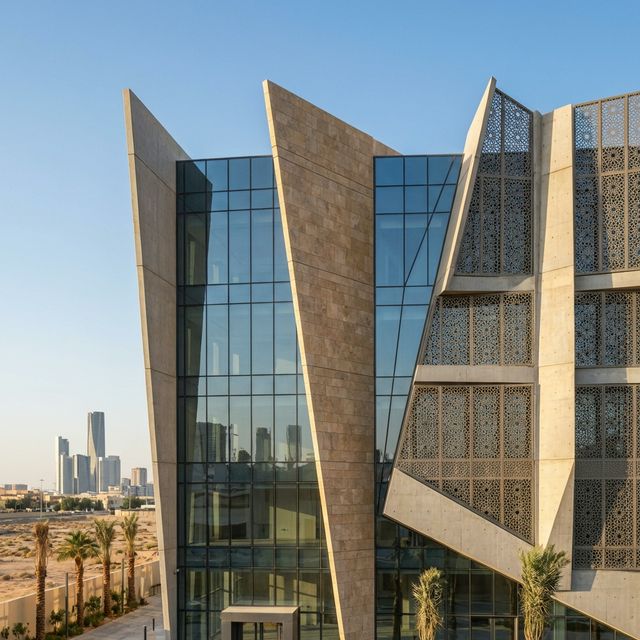
Reality: Plots do not rotate, but plans do. Shading devices, deep reveals, careful glazing ratios, courtyards, service zones placed on the hottest elevation and a thoughtful roof strategy all reduce the penalty substantially. A good design on an awkward aspect regularly outperforms a careless design on a favourable one.
How to check it yourself: Ask for two layout options on the same plot and compare glazing area by elevation and predicted load.
Myth 5: Privacy planning and orientation are separate problems.
Reality: They are the same problem seen twice. The elevation you want to open for light is often the one facing a neighbour or a street, so daylight, privacy and solar control have to be resolved together. Solving one at a time usually ends with small windows everywhere, which is how buildings become dark and still hot.
How to check it yourself: Review window positions against both the sun path and the neighbouring windows on a single drawing.
Myth 6: Orientation only matters for the top floor or the facade.
Reality: It affects the whole building, including how much plant is needed, where risers run, how outdoor space is usable and how much the external envelope costs to protect. It also affects tenant satisfaction and therefore renewals, which is a revenue question rather than a comfort one.
How to check it yourself: Ask whether the cooling capacity and the facade specification in the cost plan reflect the chosen orientation.
What this changes in your decision
- Treat aspect as a design input and a running cost driver, not as a reason to pay more for land.
- Require a cooling load comparison between layout options before design is frozen.
- Resolve daylight, privacy and solar control on one drawing rather than in three separate reviews.
- Put the facade and plant implications of the chosen orientation into the cost plan explicitly.
- Ask for comparable evidence before accepting that aspect changes market value in your district.
Domira designs, builds and manages projects across Saudi Arabia for owners who are based abroad: land appraisal, feasibility, design, construction, handover and asset management under one accountable contract. Send us the plot or the brief and Domira will put the numbers in front of you before you commit.
Frequently Asked Questions
Does plot orientation affect property value in Saudi Arabia?
Less than most buyers assume. Permitted area, location, access and product quality dominate value, and aspect is usually a secondary factor that may or may not appear in comparable evidence for a given district. Where it matters most is running cost and occupant comfort, which affect operating expenses and tenant retention rather than the headline price per square metre.
Which orientation is best for a villa in a hot Saudi climate?
There is no single answer, because it depends on which rooms are used at which times and on how the plot is shaped and overlooked. The general principle is to limit large glazed areas on the hottest afternoon elevation, place service spaces there instead, and shade whatever glass remains. Ask your designer to model the options for your actual plan.
Can good design compensate for a poor plot aspect?
To a large extent, yes. Shading, glazing ratios, courtyards, insulation performance and the placement of service zones can reduce the penalty of an unfavourable aspect significantly. The condition is that the decisions are made during design rather than after the plan is fixed, because once openings and layouts are set the remaining options are mechanical and expensive.
Have a Property Question?
Domira can help you navigate property, financing and investment decisions in Saudi Arabia. Speak with our team for an initial consultation.

