
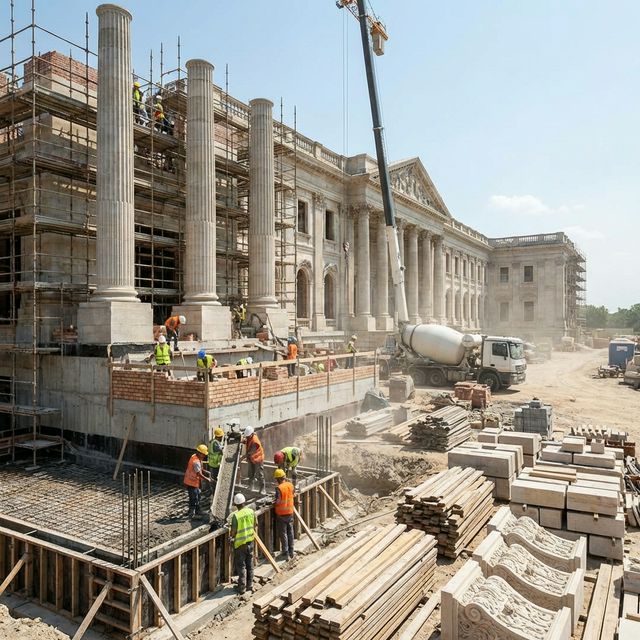
Handing a Saudi project to a single accountable company versus appointing designer, contractor and manager separately, compared on accountability, cost and what you must supervise.
For an owner based abroad the real choice is not a contract form, it is how many relationships you are willing to manage across a time difference. One company covering design, construction and then management of the finished asset gives you a single accountable counterparty. Appointing each role separately gives you independence at every interface, at the price of being the person who joins them together.
One accountable company at a glance
A single firm takes the project from brief through design and construction into operation of the completed building. You have one contract, one programme, one reporting line and one entity to hold responsible when a target is missed. Nobody can tell you that the delay belongs to somebody else. The exposure is concentration: if that company underperforms or its priorities shift, you have no second party inside the project whose interest is to tell you.
A team you assemble at a glance
You appoint an architect, a contractor, a cost consultant and later a property manager, each on its own contract, and either manage them yourself or hire a development manager to do it. Every party checks another, and you can replace any one of them without disturbing the rest. In exchange you own the gaps between contracts, and gaps are where cost and time leak on a project run from another country.
Accountability when a date slips
One accountable company: One party answers, and the remedy sits in one contract.
A team you assemble: Responsibility is argued between parties, and you decide who is right.
Independence of information
One accountable company: Lower: the reports come from the party being measured, unless you fund your own reviewer.
A team you assemble: Higher: cost consultant and designer report on the contractor and on each other.
Cost of coordination
One accountable company: Priced inside one fee and largely invisible to you.
A team you assemble: Real but visible, either in your own time or in a development management fee.
Flexibility to change a party
One accountable company: Poor, because replacing the company means restarting the relationship across every stage.
A team you assemble: Good, because each appointment ends or is replaced without touching the others.
Continuity into operation
One accountable company: Strong: the company that built the asset is still present when the first defects appear.
A team you assemble: Weak unless deliberately arranged, because the builder leaves at handover.
What you must personally supervise
One accountable company: The brief, the gates and the monthly report you insist on receiving.
A team you assemble: Every interface, every certificate and every change order across several contracts.
When one accountable company wins
- You are a first-time owner in the Kingdom without a local team or representative.
- The project is modest in value, so three separate appointments would each be too small to attract strong firms.
- You want one monthly report that reconciles design, cost, programme and later income.
- You intend to hold the asset and want the builder still accountable when defects appear in operation.
When a team you assemble wins
- The project is large enough that each role can attract a specialist firm on its merits.
- You already have a trusted representative or development manager in the Kingdom.
- Investors or lenders require independent cost reporting and certification.
- The asset is unusual and you want the best available firm in each discipline rather than one generalist.
How to decide
If you have no presence in the Kingdom and the project is a normal building type, take the single accountable company and spend part of the saving on an independent technical review at defined gates. If you have a representative on the ground, a lender requiring independent certification, or an unusual asset, assemble the team and appoint a development manager whose only job is the interfaces. The wrong combination is assembling a team and supervising it yourself from another time zone.
Count the decisions you will have to make in a month under each model, then be honest about how many you can make within a working day of being asked. Delay in owner decisions is one of the most common causes of extension claims, and it grows with the number of parties waiting on you. If your realistic response time is a week, reduce the number of people waiting.
Domira designs, builds and manages projects across Saudi Arabia for owners who are based abroad: land appraisal, feasibility, design, construction, handover and asset management under one accountable contract. Send us the plot or the brief and Domira will put the numbers in front of you before you commit.
Frequently Asked Questions
Is it risky to give one company the design, construction and management of a project?
The risk is concentration rather than the model itself. Manage it with staged gates where you can stop, a payment schedule tied to measured progress, an independent technical review at key stages, and an agreement that ends cleanly if performance fails. Written that way, single accountability usually gives an absent owner more control than four contracts nobody is joining together.
What does a development manager do that an owner cannot do remotely?
A development manager holds the interfaces: chasing approvals, reviewing the contractor claims against measured progress, running change control, keeping the design team and builder aligned and producing one reconciled report. Most of that work is presence and timing rather than expertise. It is the part of ownership that cannot be done in an evening email from another country.
Should the company that builds my project also manage it afterwards?
It can work well, because defects are fixed by the party that created them and operating knowledge is not lost at handover. Keep the two mandates in separate agreements with separate fees and a clear performance test for the management role, so you can end the management appointment without disturbing construction warranties. Also require that defect reporting is not filtered by the manager who built the asset.
Have a Property Question?
Domira can help you navigate property, financing and investment decisions in Saudi Arabia. Speak with our team for an initial consultation.

