
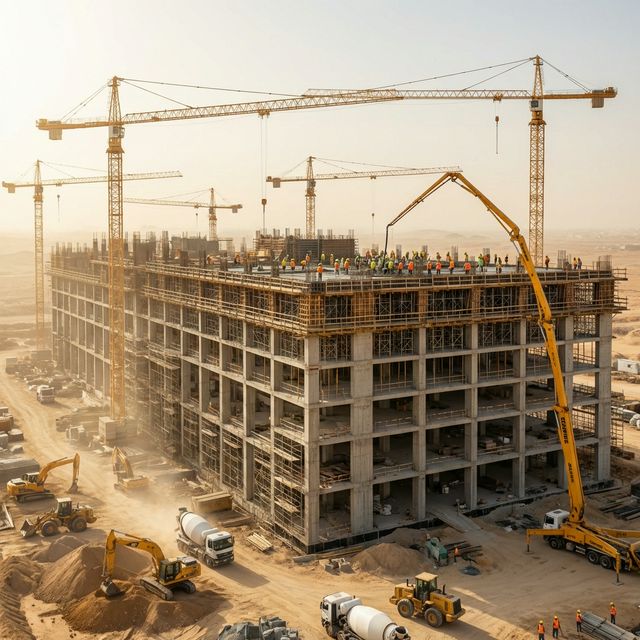
An owner who suspects the numbers have drifted can commission a review of the project accounts. Here is what such a review examines and what it costs to run.
An independent cost review examines whether what you have paid matches what has been built and what the contract allows. It is commissioned when certified value and visible progress stop matching, when variations have grown without explanation, or before settling a final account. The exercise costs money and time, and it pays for itself only if you are willing to act on what it finds.
What this number does and does not include
This covers a commercial and technical review of a live or recently completed construction project commissioned by the owner. It is not a statutory financial audit of a company, and it does not replace legal advice on the contract or advice on tax treatment of the amounts involved.
Document assembly and review
Gathering the contract, priced schedules, instructions, valuations, certificates, programmes and correspondence, then establishing what the baseline actually was.
- Pushes it up: Records scattered across inboxes and phones, missing signed documents, and contracts amended by side letters.
- Brings it down: A single project folder with a consistent structure maintained from the first month.
- How to control it: Keep the project file audit ready throughout, which also reduces what any future dispute costs you.
Remeasurement of work in place
Physically measuring or verifying a sample of the works against the quantities that have been paid for.
- Pushes it up: Concealed work with no inspection records, complex geometry, and a large number of small items.
- Brings it down: Good as built records, photographs of concealed work, and joint measurement sheets from each valuation.
- How to control it: Photograph and record every element before it is covered, so remeasurement becomes a desk exercise rather than opening up work.
Variation account examination
Testing each variation against an instruction, the contract rates and the tender documents, including whether it was a change at all.
- Pushes it up: A long list of loosely described items, lump sum pricing without breakdown, and verbal instructions.
- Brings it down: A numbered variation register with priced quotations and instruction references.
- How to control it: Refuse lump sum variation pricing during the project, and the audit of it later becomes straightforward.
Programme and time cost review
Checking whether time related costs paid or claimed are supported by the programme and by records of resources on site.
- Pushes it up: No accepted baseline, no monthly updates, and claims built on daily rates rather than incurred cost.
- Brings it down: Monthly programme updates kept as separate files with site diaries for the same periods.
- How to control it: Keep programme updates and diaries filed monthly, because reconstructing them later is the most expensive part of any review.
Reviewer fees and site time
The fee for the quantity surveyor, engineer or consultant carrying out the review, plus travel and site attendance.
- Pushes it up: Multiple site visits, poor records requiring reconstruction, and a scope that keeps expanding as findings emerge.
- Brings it down: A tightly written scope with a defined sample, and a clear question the review must answer.
- How to control it: Commission the review in two stages: a short diagnostic on the records, then a full review only if the diagnostic justifies it.
Disruption to the live project
The cost of the project team spending time on the review and of the relationship strain it creates while work continues.
- Pushes it up: Announcing an audit without explanation, requesting everything at once, and doing it during a critical phase.
- Brings it down: Framing the review as a routine account reconciliation and scheduling it away from critical activities.
- How to control it: Tell the contractor what the review covers and why, and give them the chance to explain items before conclusions are written.
Acting on the findings
The cost of pursuing what the review identifies: negotiation, adjustment of the final account, or formal proceedings.
- Pushes it up: Findings that rest on weak records, and amounts small enough that pursuit costs more than recovery.
- Brings it down: Findings supported by documents, pursued through the contract mechanisms rather than by confrontation.
- How to control it: Decide before commissioning the review what threshold of finding you would actually act on, and take legal advice before any formal step.
Costs that never appear on the first page
- Opening up concealed work to verify quantities, then making it good again.
- The contractor claiming time and cost for supporting the review, depending on what the contract says.
- A cooperative relationship becoming formal, which slows every subsequent approval.
- Findings that arrive after the money has been certified and paid, when recovery is much harder.
- Advisers reviewing the review, which happens whenever the amounts become material.
Keeping the budget honest
Commission the review while money is still unpaid, because recovery before certification is negotiation and recovery afterwards is litigation. Scope it around a specific question, set a fee ceiling for the first stage, and decide in advance what size of finding would justify a full review and what you would do with it.
- When certified value and assessed physical progress diverge for two consecutive months.
- When the variation account passes a threshold you set at the outset.
- Before agreeing the first retention release, while you still hold money.
- Before signing off the final account, which closes your position on everything.
Domira designs, builds and manages projects across Saudi Arabia for owners who are based abroad: land appraisal, feasibility, design, construction, handover and asset management under one accountable contract. Send us the plot or the brief and Domira will put the numbers in front of you before you commit.
Frequently Asked Questions
When should an owner commission an independent review of construction costs?
The best triggers are quantitative rather than emotional: a persistent gap between money certified and work in place, a variation account exceeding a threshold you set in advance, or the approach of a final account. Reviewing before a payment or a release is far more useful than reviewing afterwards, because unpaid money is the only leverage that makes findings worth something.
Can a contractor refuse access for an independent cost review?
Access to the site and to records is governed by the contract, and most contracts give the owner or their representatives rights of inspection and require records to be kept and made available. What the contractor can resist is a request that goes beyond those rights. Check your clauses before announcing a review, and if the rights are narrow, ask a licensed adviser how to proceed without breaching the contract yourself.
Does an independent cost review usually recover more than it costs?
It depends almost entirely on the quality of your records and on whether money remains unpaid. Reviews commissioned early on projects with a clear baseline and disciplined registers frequently identify enough to justify themselves. Reviews commissioned after final payment, on projects with verbal instructions and no programme updates, often produce a well argued document that cannot be enforced.
Have a Property Question?
Domira can help you navigate property, financing and investment decisions in Saudi Arabia. Speak with our team for an initial consultation.

