
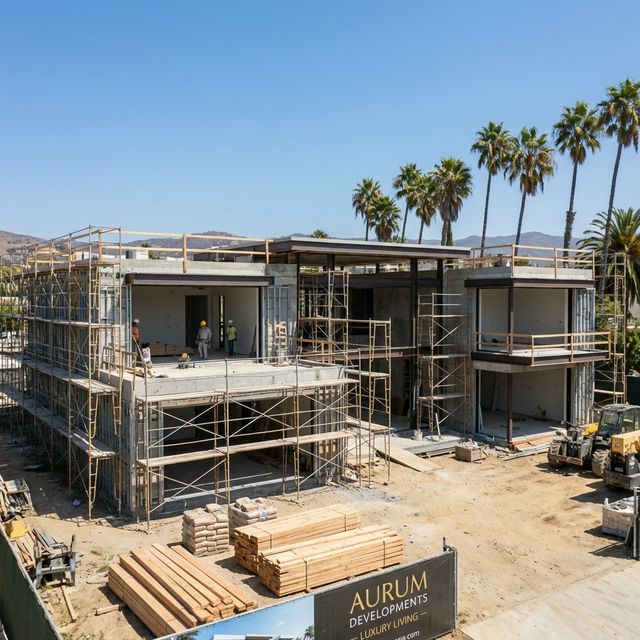
The trade-off between a single firm that designs and builds, and a designer appointed separately from the builder, judged on control, price certainty and who carries the risk.
One firm designing and building gives you a single point of responsibility and an earlier fixed price. A designer appointed separately from the builder gives you an independent voice checking the work of the company you are paying. For a foreign owner the question is usually which risk you can manage from a distance: coordination risk between two parties, or the risk of the same company judging its own workmanship.
Single design-and-build firm at a glance
You appoint one company to take your brief, produce the design and construct the building. Responsibility for the design working as built sits with that company, so a clash between drawing and reality is its problem to solve rather than yours to arbitrate. Price can be fixed earlier because the designer and the builder are the same commercial interest. The cost of that neatness is that the party doing the work also decides what is good enough, unless you appoint your own reviewer.
Separate designer and contractor at a glance
You appoint an architect and engineers to design and document the building, then tender that documentation to contractors and appoint one to build it. The designer stays engaged during construction to inspect, review submittals and certify payments, which gives you a professional whose interest is the quality of the building rather than the cost of building it. In exchange you carry the gap between design and construction: if the drawings are incomplete, the contractor prices the uncertainty or claims later.
Who carries design risk
Single design-and-build firm: The single firm carries it, so a buildability failure is corrected at its cost under one contract.
Separate designer and contractor: You carry it through your designer, and the contractor can claim where documents are incomplete or late.
When you get a reliable price
Single design-and-build firm: Earlier, often from a developed brief, though the price depends on how tightly the brief is written.
Separate designer and contractor: Later, after documentation is complete enough to tender, but based on a defined scope.
Quality control
Single design-and-build firm: Weaker unless you appoint an independent reviewer, because the builder inspects its own output.
Separate designer and contractor: Stronger by structure, since the designer inspects and certifies work it did not perform.
Programme
Single design-and-build firm: Usually shorter, because construction can overlap detailed design under one manager.
Separate designer and contractor: Usually longer, because design completion and tendering sit before site work begins.
Ease of changing your mind
Single design-and-build firm: Changes are simple to instruct and harder to price fairly, since there is no competing benchmark.
Separate designer and contractor: Changes go through a valuation process against tendered rates, which is slower but more testable.
Demand on your time
Single design-and-build firm: Lower day to day, higher at brief stage, because the brief is the only thing you truly control.
Separate designer and contractor: Higher throughout, with decisions on drawings, samples and certificates spread over the programme.
Cost of getting it wrong
Single design-and-build firm: A weak brief produces a compliant building you did not want, with little contractual remedy.
Separate designer and contractor: Incomplete documents produce claims and extensions that erode the tendered price advantage.
When single design-and-build firm wins
- You are outside the Kingdom and cannot referee arguments between a designer and a builder.
- The building type is well understood, such as apartments, warehousing or a standard commercial shell.
- Speed matters and you want construction to start while detailed design continues.
- You want one contract, one programme and one entity holding the warranties.
When separate designer and contractor wins
- The design itself carries the value, as in a distinctive residential or hospitality building.
- You want competitive tendering on a complete design to test the market price.
- Specification control matters because you will sell or let on quality of finish.
- You want independent certification of progress before each payment is released.
How to decide
Choose the single firm when the building is conventional, your brief can be written precisely and you will not be present to manage two parties. Choose separate appointments when the design is the product you are selling, when you want the market to price a finished document, or when investors require independent certification. If you take the single firm route from abroad, fund an independent technical reviewer on your side; it is a small cost that restores the check you gave up.
Test the choice against your own brief. Write the ten requirements that must be true for the building to succeed commercially, then ask whether a single company could deliver them from that page alone. If the answer is yes, the design-and-build route is safe. If your list includes things you would recognise only when you saw them, you need a designer whose duty is to you rather than to the builder holding the construction margin.
Domira designs, builds and manages projects across Saudi Arabia for owners who are based abroad: land appraisal, feasibility, design, construction, handover and asset management under one accountable contract. Send us the plot or the brief and Domira will put the numbers in front of you before you commit.
Frequently Asked Questions
Is design and build cheaper than appointing an architect and contractor separately?
Not reliably. It usually costs less in time and coordination, and it reduces claims arising from incomplete documents, but you lose competitive tendering on a finished design and you lose the independent voice on specification. Foreign owners often find the true comparison is total outcome cost, including delay and rework, rather than the contract sum agreed at the start.
Can I appoint my own consultant to supervise a design-and-build contractor?
Yes, and from abroad you should. An owner representative or technical reviewer inspects work, reviews submittals, checks progress claims and reports to you, without taking design responsibility away from the contractor. Define the reviewer scope carefully so it does not become instruction: if your consultant starts directing the work, the contractor may argue that design responsibility shifted.
Which route gives more control over the finishes in a Saudi residential project?
Separate appointment, because your designer specifies materials and rejects substitutions without a commercial interest in the cheaper option. Under design and build you can still control finishes, but only through the specification written into the contract, sample approvals and a named schedule of products. Vague wording such as high quality finishes transfers the choice to the party paying for them.
Have a Property Question?
Domira can help you navigate property, financing and investment decisions in Saudi Arabia. Speak with our team for an initial consultation.

