
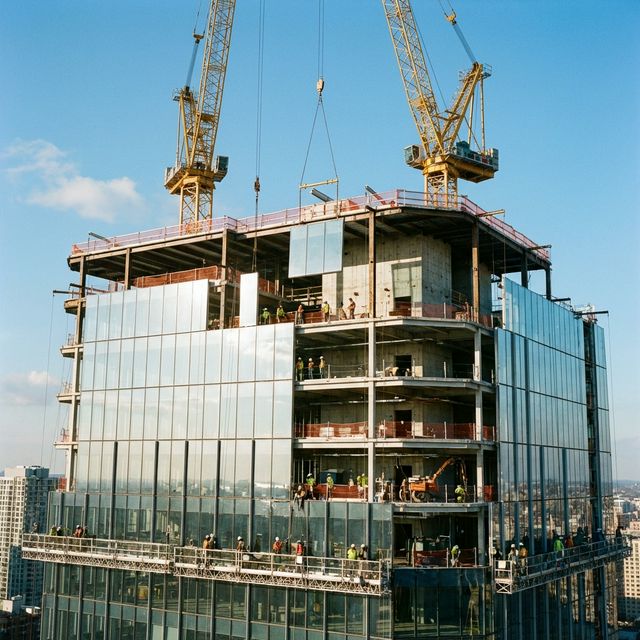
Construction spending is not spread evenly across the programme. Knowing the shape of the curve decides how much cash you need and when.
Construction cost accumulates as a shallow start, a steep middle and a long tail. The shape matters because your obligation to pay follows the curve, not the calendar, and financing drawn evenly across a build either sits idle early or runs short in the middle. This example builds the curve for a single building and tests it against two funding patterns.
The situation
An owner abroad is funding a small apartment building from savings plus a facility. The total construction budget is SAR 12,000,000 over a twelve month programme, and the owner wants to know the maximum cash required in any month.
Assumptions (illustrative)
- Construction budget: SAR 12,000,000 over twelve months.
- Substructure and structure, months one to five: 45 per cent of the budget.
- Envelope and services rough in, months five to nine: 30 per cent of the budget.
- Finishes, testing and external works, months nine to twelve: 25 per cent of the budget.
- Retention withheld from each payment: 5 per cent.
- Payment terms: certified monthly, paid the following month.
- These proportions and amounts are illustrative assumptions used to demonstrate the method.
Step 1: Convert phase percentages into monthly amounts
Structure is 45 per cent of SAR 12,000,000, or SAR 5,400,000 over five months, roughly SAR 1,080,000 per month. Envelope is SAR 3,600,000 over four months, SAR 900,000 per month. Finishes are SAR 3,000,000 over three months, SAR 1,000,000 per month.
Even this crude split shows that the heaviest monthly commitment falls in the first phase, not at the end as owners often expect.
Step 2: Deduct retention to find the cash actually paid
At 5 per cent retention, a certified SAR 1,080,000 is paid as SAR 1,026,000, and SAR 54,000 is held.
Retention smooths the curve slightly during the works and creates two lumps later when it is released.
Step 3: Shift payments by the credit period
With certification monthly and payment the following month, month one work is paid in month two, so your cash requirement begins one month after site activity does.
One month of credit is genuine working capital relief, and losing it by agreeing to pay on application changes your funding requirement immediately.
Step 4: Find the peak monthly outflow
The highest monthly payment is roughly SAR 1,026,000 during the structure phase, occurring in months two to six.
Your facility or savings must clear this figure five times in succession, which is a different test from covering the total.
Step 5: Check cumulative cash at the halfway point
By the end of month six, cumulative certified value is about SAR 6,300,000 and paid cash about SAR 5,700,000, so roughly 48 per cent of the cash leaves in the first half.
Half the money goes out before the building looks like anything, which is the single most useful fact to give a funder or a co investor.
Step 6: Add the retention releases
Total retention of about SAR 600,000 is released in two tranches, typically half at completion and half at the end of the defects period.
Two payments fall after the building is finished, which owners frequently forget when planning the first year of operating cash.
What changes the answer
- If the structure phase runs long, the peak month persists rather than rising, which strains a facility with a fixed drawdown schedule.
- If materials on site are payable, the curve steepens early because large orders are paid before they are installed.
- If payment terms move from thirty days to on application, the whole curve shifts a month earlier.
- If variations arrive late in the programme, the tail of the curve thickens exactly when funding is usually tightest.
What the numbers tell you
- Plan for the peak month, not for the total, because the total never arrives at once.
- Protect the credit period between certification and payment, since it is free working capital.
- Remember that roughly half the cash usually leaves before the building is visibly advanced.
- Hold cash for the retention releases, which arrive after the project stops feeling active.
Limits of this example
Every figure above is an illustrative assumption used to show the method, not a quote, valuation or market rate. Costs, rates, fees and regulations change and must be confirmed with the relevant authority, lender or supplier before you commit.
Domira designs, builds and manages projects across Saudi Arabia for owners who are based abroad: land appraisal, feasibility, design, construction, handover and asset management under one accountable contract. Send us the plot or the brief and Domira will put the numbers in front of you before you commit.
Frequently Asked Questions
How should an owner forecast construction cash flow before starting a build?
Take the accepted programme, spread the priced works across the activities on it, apply the payment terms and retention, then shift each amount by the credit period. The result is a monthly outflow forecast rather than a single budget figure. Ask the contractor to submit this cash flow with the baseline programme, then check it against your own funding availability month by month.
Why does construction spending peak in the middle of a project?
Because the structural phase concentrates expensive materials and plant into a short period, and because several trades overlap once the frame is complete. The early weeks are mobilisation and groundwork, and the final weeks are finishing and testing with fewer people and less material. The shape is familiar enough that a forecast which is flat across the programme is almost certainly wrong.
What happens if an owner runs short of cash mid project?
Payments slow, the contractor slows work to protect their own position, and the programme extends, which increases your cost further. It is the most damaging spiral in construction because it also weakens your position on quality and defects. If a shortfall looks likely, raise it early with the contractor and your funder, since a planned slowdown is far cheaper than a missed certificate.
Have a Property Question?
Domira can help you navigate property, financing and investment decisions in Saudi Arabia. Speak with our team for an initial consultation.

