
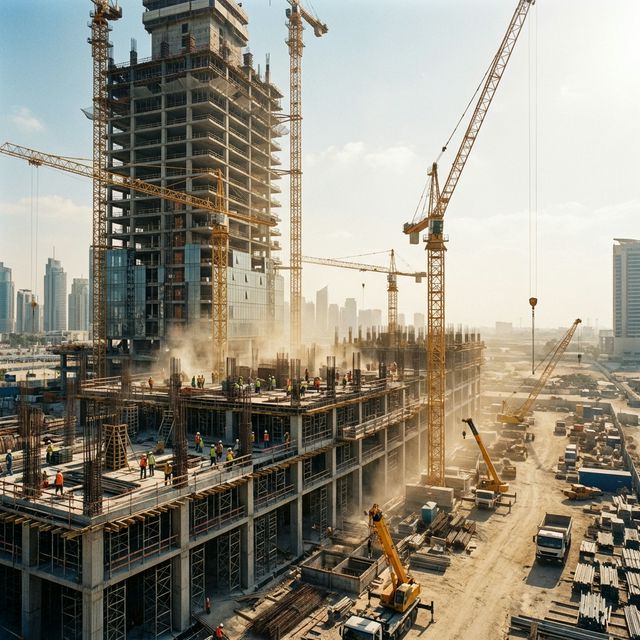
High ambient temperatures change how concrete behaves before it has any strength. The site errors that produce cracking, weakness and rework.
Concrete placed in high heat loses water faster than it gains strength. The result is plastic shrinkage cracking, reduced ultimate strength, cold joints where a pour stalls, and surfaces that dust or craze. None of it is visible in the first hour, and most of it is permanent. Hot weather concreting is a procedure rather than an opinion, and it needs to be agreed before the first pour.
Why these keep happening
These mistakes share a cause: decisions made for the convenience of the pour rather than for the behaviour of the material. Heat compresses every timescale on site, so the margin for a late truck, a missing cover or an unavailable pump disappears, and the consequence sets into the structure.
1. Pouring in the hottest part of the day
The delivery schedule is set by the plant and the site works around it.
- Avoid it by: Programme large pours for the early morning or overnight in the hot months, and agree the timing with the supplier in the contract rather than the week before.
- Proof it is closed: Pour records showing start and finish times and ambient temperature for each pour.
What it costs you: Rapid surface drying produces plastic shrinkage cracking within hours, and the placing window shortens so badly that cold joints form.
2. Adding water on site to restore workability
The mix stiffens on the way to site and the crew wants it to flow.
- Avoid it by: Specify workability retention with the supplier, use admixtures designed for the condition, and prohibit site water by a written rule everyone knows.
- Proof it is closed: Delivery tickets with recorded slump on arrival, and a signed statement that no water was added.
What it costs you: Added water raises the water to cement ratio, which directly reduces strength and durability in a way no later curing can recover.
3. Ignoring the temperature of the materials and the formwork
Attention goes to ambient air temperature, which is the number everyone quotes.
- Avoid it by: Require the supplier to manage material temperature, shade stockpiles, and cool or shade formwork and reinforcement before placing.
- Proof it is closed: Recorded concrete temperature at discharge for every load, against the specified limit.
What it costs you: Hot aggregate, hot mixing water and formwork or reinforcement standing in the sun raise the concrete temperature before it leaves the truck.
4. Starting a pour without confirming continuity of supply
The first trucks arrive on time and the crew assumes the rest will follow.
- Avoid it by: Confirm truck numbers, cycle times and a standby arrangement before the first load, and agree what happens if supply breaks.
- Proof it is closed: A pre pour checklist signed by the supervising engineer, including confirmed supply and a contingency plan.
What it costs you: A gap between loads in high heat creates a cold joint through a structural element, which is a defect that cannot be repaired by finishing.
5. Treating curing as watering when convenient
Curing happens after the visible work is finished, when attention has moved to the next activity.
- Avoid it by: Specify a continuous curing method suited to the element, such as covering and continuous wetting or an approved curing compound, and assign a named person to it.
- Proof it is closed: Curing records for each element with method, start time and duration.
What it costs you: Interrupted curing in heat is worse than none at all in some cases, and it produces surface weakness that appears as dusting and crazing later.
6. Testing samples without controlling their conditions
Cubes are taken and sent away, and the paperwork looks complete.
- Avoid it by: Require sampling, storage and transport of test specimens to follow the specified procedure, witnessed by the supervising engineer.
- Proof it is closed: Test certificates traceable to identified pours, with sampling conditions recorded.
What it costs you: Samples cured in site conditions rather than as specified give results that do not represent the concrete, so you cannot tell whether a problem exists.
7. No traceability from pour to element
Tickets and test results accumulate without being linked to locations.
- Avoid it by: Record for every pour the element, location, delivery tickets, sample references, times and temperature, on one sheet.
- Proof it is closed: A pour register that lets any test result be traced to a specific element.
What it costs you: If a result is low, nobody can say which part of the structure it belongs to, so the investigation expands to everything poured that week.
A short check before you sign
- Are pour times recorded with ambient and concrete temperature?
- Is there a written prohibition on adding water at the point of discharge?
- Does a pre pour checklist confirm supply continuity and a contingency?
- Are curing method and duration recorded for each element?
- Can any test result be traced to a specific pour and location?
- Were test specimens stored and transported as specified?
If it has already happened
If cracking or low strength results have already appeared, do not let the contractor decide the significance of it. Ask the structural engineer to assess whether the affected element meets the design requirement, using the test data and, where needed, testing of the structure itself. Some outcomes are cosmetic, some require strengthening and a few require removal, and the decision belongs to the designer rather than to whoever placed the concrete. Record the assessment, because a structural question closed with documents is closed, and one closed with reassurance reopens at resale.
Domira designs, builds and manages projects across Saudi Arabia for owners who are based abroad: land appraisal, feasibility, design, construction, handover and asset management under one accountable contract. Send us the plot or the brief and Domira will put the numbers in front of you before you commit.
Frequently Asked Questions
What temperature is too hot for pouring concrete?
Rather than a single figure, specifications work with limits on the temperature of the concrete at discharge and with required precautions above defined ambient conditions. The practical point for an owner is that the limit must be stated in the specification, measured at every delivery and recorded, and the supplier must be contractually responsible for meeting it. Confirm the applicable requirements with your structural engineer against the Saudi Building Code provisions for your project.
Why does concrete crack shortly after pouring in hot weather?
Because water evaporates from the surface faster than it can be replaced from within, the surface contracts while the body of the concrete does not, and the surface tears. These plastic shrinkage cracks appear within hours, often before any strength has developed. They are prevented by reducing evaporation through timing, shading, wind screening and immediate curing rather than by repairing afterwards.
Can concrete be poured at night in Saudi Arabia?
Night pouring is a common and effective response to summer heat, and for large pours it is frequently the right decision. It requires lighting, supervision cover, agreement with the supplier on delivery hours, and compliance with any local restrictions on night working, which should be confirmed with the municipality. Budget for the supervision, because a night pour without an inspector present defeats the purpose.
Have a Property Question?
Domira can help you navigate property, financing and investment decisions in Saudi Arabia. Speak with our team for an initial consultation.

