
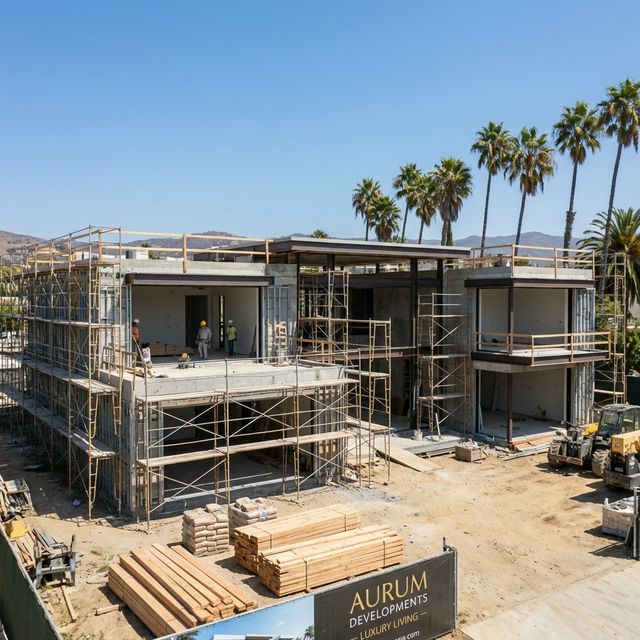
Seven location judgements that look sound on a map and fail in the appraisal, and the checks that separate a good address from a good development site.
A plot can sit in a desirable district and still be a poor development site. Location for a developer is not the same as location for a buyer: you are judging what can be built, what it will cost to build there, and who will occupy it in three years, not how the street feels today. These are the location errors that recur most often among owners buying from outside the Kingdom.
Why these keep happening
The common thread is that the owner assesses the plot as a consumer rather than as a producer. Photographs, drive-by impressions and a broker's account of the neighbourhood answer the question of whether you would live there. They do not answer whether the plot yields enough area, whether services reach it, whether the road it fronts will still be quiet after the next phase of construction, or whether the tenants you are counting on are the ones moving into that district.
1. Judging the district instead of the plot
District-level reasoning hides plot-level facts. Two sites four hundred metres apart can differ in permitted use, permitted height, road width, service availability and the direction the area is growing. The district gives you a demand story; the plot decides whether you can build the product that story needs.
- Avoid it by: Getting a written planning position for the individual plot before price negotiation, not for the neighbourhood.
- Proof it is closed: A dated envelope study naming the plot and converting it into permitted area.
What it costs you: A scheme redesigned downwards after purchase, with the appraisal margin absorbed by the reduction in saleable area.
2. Ignoring the road the plot actually fronts
Frontage decides access, visibility, permitted use in many cases, and how a building has to be arranged. A commercial idea on a narrow residential street rarely survives the approval stage, and a residential building on a heavy commercial route struggles to let at the rent the appraisal assumed.
- Avoid it by: Standing on the plot at two different times of day and confirming the road classification with the municipality.
- Proof it is closed: A note in the file recording road width, classification and the use it supports.
What it costs you: Either a refused or restricted use, or a completed building that has to compete on price because its address works against it.
3. Assuming services are present because neighbours are built
Electricity, water and drainage reaching the street is not the same as a connection available to your plot at the capacity your scheme needs. A building with more units than the surrounding villas can require a substantially larger supply, and that is an application, a cost and a wait rather than a formality.
- Avoid it by: Asking your engineering office to confirm available capacity for the intended scheme, not merely the presence of a network.
- Proof it is closed: Written confirmation of the connection route and required capacity for your unit count.
What it costs you: Unbudgeted connection and infrastructure works, and a completion date that slips because power arrives after the building is finished.
4. Buying into a growth story with no anchor
Land on the edge of a city is cheap because demand has not arrived. Sometimes it arrives, driven by a road, a transport line, employment or a large scheme nearby. Often it arrives years later than the seller suggests, and you carry holding costs the whole time without income.
- Avoid it by: Requiring a named, funded anchor for demand, and testing the appraisal with a later start and slower sales.
- Proof it is closed: A written demand rationale naming what will bring occupiers, with your own sensitivity run attached.
What it costs you: Years of dead capital, holding costs on undeveloped land, and a product completed into a market that is not yet there.
5. Overpaying for a view or a corner you cannot monetise
Premium attributes are only worth paying for if the product can charge for them. A view that half the units cannot see, or a corner whose value depends on a retail use the plot does not permit, adds to the land price without adding to revenue.
- Avoid it by: Quantifying the premium in the appraisal before agreeing it in the price, unit by unit.
- Proof it is closed: A revenue schedule showing which units carry the premium and how much of it.
What it costs you: A land price that no scheme on that plot can justify, which shows up as a negative residual value.
6. Treating access during construction as a detail
A plot with one narrow approach, no space for deliveries and neighbours on three sides is more expensive to build on. Craneage, storage, working hours and traffic management all become constraints, and contractors price constraints when they can see them and claim for them when they cannot.
- Avoid it by: Walking the delivery route before purchase and asking a contractor for a constructability view on the site.
- Proof it is closed: A site logistics note in the tender documents so every bidder prices the same constraint.
What it costs you: Higher preliminaries, slower progress and disruption claims that were never in the budget.
7. Relying on a single source for the whole location view
The broker who introduced the plot is paid when it sells. That does not make the information wrong, but it makes it incomplete. When the demand story, the price evidence and the planning position all come from one interested party, you have one opinion presented as three facts.
- Avoid it by: Sourcing planning from the municipality, price evidence from an accredited valuer, and demand from your own occupier conversations.
- Proof it is closed: Three independent documents in the file, each with a date and an author.
What it costs you: A purchase justified entirely by material produced by the seller side, with no independent evidence if it goes wrong.
A short check before you sign
- A written planning position for this plot, from the municipal authority, dated.
- Confirmation of service capacity for the intended number of units, not the street.
- A survey showing boundaries, levels and anything crossing the site.
- An independent view on land value from an accredited valuer.
- A named reason why occupiers will be here when the building completes.
- A constructability comment from someone who builds, not only from someone who designs.
If it has already happened
If you already own a plot that does not suit the scheme you planned, do not force the scheme. Re-run the envelope study and the appraisal on what the plot actually permits, and compare three honest options: build the product the plot suits, hold the land with the smallest possible carrying cost while the district develops, or sell and redeploy. The expensive route is the fourth one, which is to build the original idea anyway on a site that cannot carry it.
Domira designs, builds and manages projects across Saudi Arabia for owners who are based abroad: land appraisal, feasibility, design, construction, handover and asset management under one accountable contract. Send us the plot or the brief and Domira will put the numbers in front of you before you commit.
Frequently Asked Questions
How do I check what can be built on a plot in Saudi Arabia before I buy it?
Ask a licensed Saudi engineering office to obtain and interpret the planning position for that specific parcel, covering permitted use, coverage, floors, setbacks and parking. Requirements differ by city and district and are updated over time, so the office should confirm the current position with the municipal authority for your plot rather than inferring it from neighbouring buildings.
Is land on the edge of a Saudi city a good development buy?
It can be, when something specific is bringing occupiers: a new road, a transport line, a major employer or a large funded scheme nearby. Without a named anchor you are funding a wait. Test the appraisal with a later construction start and a slower sales rate, and include the holding costs, including any levy that applies to undeveloped land.
Does a corner plot always develop better than a mid-terrace plot?
Not automatically. A corner gives you two frontages, more daylight and often better visibility, but it also brings two setback lines, which can reduce the buildable footprint. Whether it is worth a premium depends on whether your product can charge for the frontage. Compare the permitted area and the achievable revenue, not the shape on the map.
Have a Property Question?
Domira can help you navigate property, financing and investment decisions in Saudi Arabia. Speak with our team for an initial consultation.

